Space and Physics
 PUBLISHED


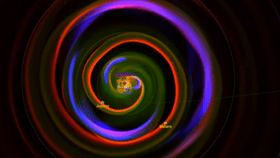


Solar winds stream through the vacuum of space at an awesome 400 kilometers per second (over one million miles per hour). To help understand the effect of these “gusts” on the space environment, NASA developed this hypnotic visualization.
The sun is continually producing solar winds, although they can vary in strength, temperature and consistency. They consist of charged particles of electrons and protons that are thrust forward by the thermal energy and magnetic fields of the Sun’s atmosphere. The effect of the Aurora Borealis (or the Northern Lights) is the result of solar winds as they hit the Earth’s atmosphere. The swirling shape of the winds you see in the video comes from the rotation of the Sun.
Scientists at NASA’s Goddard Space Flight Center in Greenbelt, Maryland, made this visualization using data from New Horizons and models of solar winds. As you can see by the little date and clock on the bottom right, these solar winds can take months and months to reach Pluto despite their stunning speeds.