Space and Physics
 PUBLISHED
 2
2



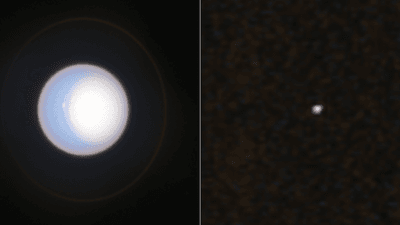


Studying exoplanets is not easy. Despite enormous steps forward in technology, models, and observational tricks, astronomers are still looking at small dots either blocking some starlight or reflecting it while being next to a bright object that easily outshines them. It requires practice, and researchers have decided to use Uranus to get better at it.
They used two space-based observatories. Around Earth, there’s the Hubble Space Telescope, which can deliver detailed views of the icy planet even when it is 2.7 billion kilometers (1.7 billion miles) away. Then there is New Horizons. The spacecraft traveled past Pluto nine years ago, and then by a small primordial object called Arrokoth. Back in September 2023, it was over 10 billion kilometers (6.5 billion miles) from Uranus – and researchers made it look at it.
Hubble can see the rings and even storms on Uranus, but for New Horizons – not designed for these types of observations – the ice giant planet is just a pale azure dot. It is not dissimilar from how some exoplanets have been seen by telescopes. So the team was able to combine the two to better understand how the little information from a tiny dot translates to global properties of a planet.
"While we expected Uranus to appear differently in each filter of the observations, we found that Uranus was actually dimmer than predicted in the New Horizons data taken from a different viewpoint," lead author Samantha Hasler of the Massachusetts Institute of Technology in Cambridge and New Horizons science team collaborator, said in a statement.
The observations showed that the planet’s brightness did not change as the planet rotated, and this was true for both observatories. Despite the presence of clouds on gas giants, they might not always have a measurable effect on observations. The orientation of the planet and how much light it reflects also matter, and New Horizons actually showed that exoplanets might be dimmer during certain phases.
"These landmark New Horizons studies of Uranus from a vantage point unobservable by any other means add to the mission's treasure trove of new scientific knowledge, and have, like many other datasets obtained in the mission, yielded surprising new insights into the worlds of our Solar System," added New Horizons principal investigator Alan Stern of the Southwest Research Institute.
NASA has two upcoming missions that will study exoplanets. The Nancy Grace Roman Space Telescope, set to launch in 2027, and the future Habitable Worlds Observatory, which is in an early planning phase.
"Studying how known benchmarks like Uranus appear in distant imaging can help us have more robust expectations when preparing for these future missions," concluded Hasler. "And that will be critical to our success.
This work was presented this week at the 56th annual meeting of the American Astronomical Society Division for Planetary Sciences, in Boise, Idaho.