Space and Physics
 PUBLISHED


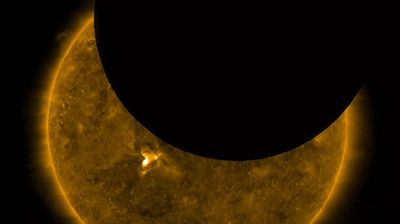


NASA has some truly spectacular sungazing instruments, and one just caught the Moon passing in front of the Sun in a glorious partial eclipse seen from space.
NASA’s Solar Dynamics Observatory – often outshone by its flashier sibling the Parker Solar Probe – shines a spotlight on the Sun 24 hours a day. At least, it did until last week, when an Earthly power shortage meant it was down for a few days. However, it sprang back into life on June 28, just in time to capture the Moon passing in between the observatory and the Sun on June 29 for a lovely partial eclipse.
At the peak of the eclipse, the Moon covered 67 percent of the Sun, and its "mountains were backlit by solar fire," as Spaceweather.com poetically described it.

The Solar Dynamics Observatory (SDO) caught the eclipse from its unique vantage point in space; it wasn't visible from Earth. However, we will get one on October 25 that should be visible from most of Europe, northern Africa, the Middle East, and western parts of Asia. (Don't worry, we'll give you a heads up when it's time.)
The SDO is studying how solar activity creates and drives space weather, for example, how coronal mass ejections (CMEs) can create solar storms on Earth, delivering us beautiful aurora and the occasional power outage.
The Sun is still three years away from this solar cycle's peak activity, expected to be in July 2025. However, it is already unusually active this early with a few violent flares, sunspots, CMEs, and even the rarer co-rotating interaction region (CIR) occurring recently, meaning we've been getting some pretty great space weather photography to enjoy while we keep our fingers crossed for no blackouts.