Space and Physics
 PUBLISHED


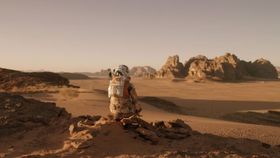


NASA has released images showing the real areas of Mars that feature in the Hollywood film and Andy Weir novel "The Martian." The images were taken by a HiRISE camera onboard NASA's Mars Reconnaissance Orbiter.
The first image shows Acidalia Planitia, the area in the story where the original Ares 3 mission landed and subsequently left NASA astronaut Mark Watney stranded.

Image: Acidalia Planitia – The Ares 3 mission landing site. Credit: NASA/JPL-Caltech/Univ. of Arizona
The other image, below, shows a shallow crater in the southwestern corner of the Schiaparelli crater, named after Italian astronomer Giovanni Schiaparelli. In the story, this is the area in which Watney has to travel 3,200 kilometers (nearly 2,000 miles) to in the hope he can be saved by the Ares 4 mission. According to NASA, this area is likely to be covered in "at least a meter thick" layer of red dust.

Image: The Schiaparelli crater – The Ares 4 mission landing site. Credit: NASA/JPL-Caltech/Univ. of Arizona
The Mars Reconnaissance Orbiter has taken more than 39,000 images with the HiRISE camera since 2006. Each image covers an area of several miles and can pick up details smaller than a car. Although don’t zoom in looking for Matt Damon, we’ve already tried.
A large bulk of the HiRISE images are available to view for free online. Another cool feature NASA has released is an online suggestion box for sites you want their HiRISE camera to photograph next.
Read this next: Physics Duo Wins The Nobel Prize For Solving Longstanding Neutrino Puzzle

 1
1