Space and Physics
 PUBLISHED


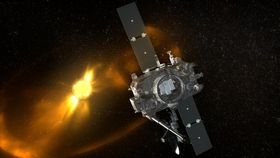


After almost two years of wandering through obscurity, NASA has found its long-lost spacecraft, STEREO-B.
NASA announced yesterday that it had reestablished contact with its STEREO-B (Solar TErrestrial RElations Observatory) spacecraft on Sunday evening after communications were lost on October 1, 2014. The spacecraft automatically undergoes a “hard reset” if it doesn’t receive communications from Earth for 72 hours. Ground control was testing out this function when an error occurred, by which time the craft had gone on a wander and its signals had became blocked by the Sun.
Speaking about this very problem in December 2015, Dan Ossing, mission operations manager for the STEREO mission, said: “The sun emits strongly in nearly every wavelength, making it the biggest source of noise in the sky. Most deep space missions only have to deal with sun interference for a day or so, but for each of the STEREO spacecraft, this period lasted nearly four months.”
The salvation of STEREO-B came through its monthly recovery operations using NASA's Deep Space Network, the cross-continental web of radio antennas and communication facilities used to keep in touch with satellites.
The spacecraft, along with its twin STEREO-A, launched in October 2006 with the aim of getting a unique glimpse into the relationship between the Sun and Earth. The duo are more or less identical, except one is ahead of Earth in its orbit and the other is behind. This partnership allows NASA to collect data on the flow of energy and matter between the Sun and Earth. It also measures the powerful solar eruptions, known as coronal mass ejections, which can trigger magnetic storms capable of “frying” satellites and power outages. You can learn more about the STEREO missions in the video below.
NASA are now in the midst of evaluating the spacecraft's health to see what comes next for this lone ranger.