Space and Physics
 1
1



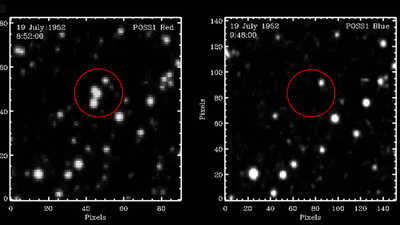


A new paper has been published on the unusual mystery of transient lights found on astronomical photographic plates. According to that new paper, the strange sources of light may represent real objects or light sources after all, hanging above the Earth in the pre-satellite era.
This one is going to require a little bit of a recap. Since 2017, the Vanishing & Appearing Sources during a Century of Observations (VASCO) project has attempted to look for sources of light in the night sky that have disappeared from view or have dimmed unusually over the 20th and 21st centuries.
That's a pretty fun and interesting goal that could help us learn about the various transient objects of the cosmos. The team has previously found that around 100 stars have disappeared from view without an explanation, for example, with other teams presenting suggestions as to where they went.
In a particularly curious study from the team, even if the explanation does turn out to be mundane, the project focused on looking at sources of light that appeared and disappeared in the pre-Sputnik era. That study identified transients captured by the Palomar Observatory Sky Survey (POSS-I), which scanned the skies from November 19, 1949, to April 28, 1957.
"These short-lived transients (lasting less than one exposure time of 50 min) have point spread functions and are absent in images taken shortly before the transients appear and in all images from subsequent surveys," the team wrote in that paper. "In some cases multiple transients appear in a single image, exhibiting characteristics not easily accounted for by prosaic explanations (e.g., gravitational lensing, gamma ray bursts, fragmenting asteroids, plate defects)."
Now, there are a number of intriguing things about these transients. The first is that they appeared in the pre-satellite era, meaning that a sudden appearance and disappearance of a point source of light cannot be put down to satellites reflecting light towards observatories on Earth. Far weirder still, according to the team, is that they appeared to be associated with nuclear tests, as well as some fairly famous sightings of unidentified aerial phenomena (UAPs).
"From 1951 until the launch of Sputnik in 1957, at least 124 above-ground nuclear tests were conducted by the United States (US), Soviet Union, and Great Britain," researchers Stephen Bruehl at Vanderbilt University Medical Center and Beatriz Villarroel at the Nordic Institute for Theoretical Physics wrote in their paper. "In some circumstances, nuclear radiation is known to cause a visible glow (i.e., Cherenkov radiation). [...] Consistent with this concept, glowing 'fireballs' in the sky were reported in multiple instances to occur shortly after nuclear tests in locations where significant nuclear fallout was expected."
Adding a sprinkle more mystery, another study by the team found that there were far fewer sightings of these transients in Earth's shadow. This suggested to the team that the sources of light were real objects, in Earth's orbit, reflecting light down at Earth. If they were plate errors, for example, you would expect to see them in all areas of the sky equally. If they are real objects reflecting light, you would expect to see fewer of them when the observatory was pointing in the direction of Earth's shadow.
While intriguing, it remained possible that what we were looking at was merely an interesting mistake in old photographic plates. It was this that the new paper, authored by retired NASA developer Ivo Busko, attempted to address. The paper has yet to be peer reviewed.
"The main problem is that a plate artifact can potentially be mistaken as a legitimate transient," Busko explains in the paper, adding that some are simple to identify, such as particles of dust or micro-hairs attached to the plate surfaces or the bed of scanners, or fingerprints and other blemishes.
"Other causes are more exotic in nature but no less damaging, such as ambient radiation, chemical issues during plate development, manufacture defects."
Another problem is time. Small particles attached to or embedded within the emulsion layer can leak chemicals into the emulsion, and sometimes over time these blemishes can start to resemble real stars that have been imaged by the same telescope.
To see whether plate defects could be the source of the transients seen by the VASCO team, Busko looked at an independent archive called Archives of Photographic PLates for Astronomical USE (APPLAUSE), which contains many photographic plates from historical telescopes based in Germany. Independent from the VASCO team, Busko used different methods to search for transients within 532 plate pairs, spanning from 1934 until the first satellite launch in October, 1957.
While we should stress that this by no means validates the whackier ideas you may have seen flying around (e.g. on Reddit) talking about UFOs visiting during nuclear tests, Busko was able to identify 11 transient events in this separate dataset.
"The transients exhibit a remarkable degree of clustering, both in time as in space," the paper explains. "All eleven showed up on only two small regions of the sky, even when appearing on separate nights. They also all happened in the period 1949 - 1953, even though the data set has about half of its plate pairs outside that window."
While we are no closer to figuring out what caused these transient objects to appear on the plates, Busko rules out asteroids reflecting light, as no blurring is visible in exposures that took 10 minutes, and no asteroids are listed as being in the correct area of the sky at the same time as the transients. As well as this, he suggests the transients seen in this dataset were likely not caused by plate defects.
"The search presented here, performed on data made available by the APPLAUSE Archive, yielded images of transients that contain the optical signature of telescope coma, which is strong evidence that these were created by light that passed throughout the optics of the telescope, and not by plate artifacts," Busko writes.
Though Busko offers no new alternatives as to what the transient events might be, the paper notes that many of them occurred around nuclear tests, including several that ran in 1951 and 1953. Previously, it had been suggested that these may represent some unknown atmospheric phenomenon relating to nuclear testing, though quite what is not clear.
While interesting, and certainly curious, much more work needs to be done in order to investigate these odd transients. It could still be that it is some sort of plate problem, but there's a small chance it could be something more interesting. Busko suggests that more work is needed to address the cause of these odd features on astronomical plates.
"Although the plate sample is not complete and homogeneous enough for us to draw a statistically meaningful conclusion, the data is consistent with the association that S. Bruehl & B. Villarroel found to exist between transients and nuclear weapon testing," Busko concludes. "On the same token, the data are also consistent with the hypothesis that these transients may be Sunlight glints generated by tumbling, mirror-like objects in space, in the vicinity of Earth."
The study is posted to pre-print server arXiv.