Nature
 PUBLISHED
 43
43


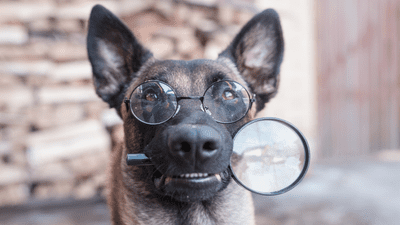


The cognitive skills of dogs were put to the test in a new study that put pooches through their paces to establish if specific traits were heritable, that is, able to be inherited. Famously talented border collies (who have featured heavily in studies about cognition) were among the 16 breeds tested, as was something of a dark horse for canine cognition, the Belgian Malinois.
To try and represent a range of cognitive talents, the study put around 1,000 participating dogs through the smartDOG cognition test, which looks at a dog’s capacity for problem-solving ability and strategy, impulse control, ability to read human gestures, ability to copy human behavior, memory, and logical reasoning.
Doing so revealed breed differences in several test conditions.
“Most breeds had their own strengths and weaknesses,” study author Saara Junttila, a PhD researcher in canine cognition at the University of Helsinki, told The Telegraph. “For example, the Labrador Retriever was very good at reading human gestures, but not so good at spatial problem-solving ability. Some breeds, such as the Shetland Sheepdog, scored quite evenly in almost all tests.”
If you’re unfamiliar with the breed, Belgian Malinois dogs are a popular choice for security work, which makes their performance in cognition tasks interesting as how they performed may be connected to their suitability for life as a working dog.
It seems their affinity for sniffing out crime and identifying targets for searches may be linked to some of their problem-solving skills. It tested well in conditions that relied on dogs interpreting human gestures, and a V-detour task that tests their ability to problem solve as they navigate their environment.
However, they weren’t without some cognitive weaknesses. Belgian Malinois sat alongside German Shepherds in being duped by the cylinder test (featured above) in which dogs are taught to retrieve a treat from inside an opaque cylinder. This is then replaced with a see-through cylinder, and a successful test sees the dog continue going inside the cylinder to retrieve it rather than trying to go the direct route through the side.
The cylinder test challenges their inhibition, as dogs must resist the urge to go direct and use their spatial awareness to instead access the treat around the side. Being lousy at holding back here may be connected to the Malinois’ role as a working dog, as security dogs require high responsiveness which is associated with low inhibitory control.
The researchers conclude that breed function can account for certain cognitive strengths, such as herding dogs and retrievers scoring highly in the human-directed behavior tasks, and that these breed differences indicate these traits probably have a hereditary component. However, this couldn't explain all breed differences as some dogs’ cognition scores sat outside what might be expected of them, such as the Finnish Lapphund that did poorly in the human-directed task despite being a herding dog.
They also outline certain caveats to the study, such as the fact that the dogs investigated are not representative of the entire dog population, but believe the research contributes towards a more complete picture of breed-typical behavior in dogs.
The study was published in Scientific Reports.
This article has been updated to reflect that these tests cannot be used to rank breeds’ intelligence, and instead are indicative of the heritability of certain cognitive traits. This included the removal of a calculation that the researchers contacted IFLScience to express was erroneously reported by The Telegraph.