Humans
 PUBLISHED
 12
12


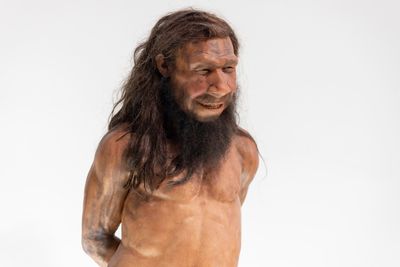


The fact that most people alive today carry a wee fraction of Neanderthal DNA proves that our prehistoric ancestors hooked up with members of this now-extinct hominin lineage. However, new genetic data reveals that these ancient affairs mainly involved human women and Neanderthal men, who were seemingly much more attracted to each other than human blokes were to Neanderthal ladies.
To uncover these surprising sexual preferences, researchers examined the sex chromosomes of both modern humans and Neanderthals. In females, these consist of a pair of X chromosomes, while males possess one X chromosome and one Y chromosome.
For years, scientists have wondered why none of our Neanderthal DNA appears on the X chromosome, resulting in this region of our genome being dubbed a “Neanderthal desert”. Up to now, one of the leading theories was that Neanderthal X chromosome genes were essentially toxic to Homo sapiens, and were therefore purged from our genome via natural selection.
“The hypothesis floating around stated that these were regions of the genome where the modern human genome was just better than the Neanderthal version of the genome,” explained study author Alexander Platt, PhD from the Tishkoff Lab at the University of Pennsylvania. “I hated this hypothesis,” he told IFLScience.
Offering an alternative, he suggests that “maybe we never really had that many of their X chromosomes to begin with, because our Neanderthal ancestors were male and didn't have that many X chromosomes to give us.”
To investigate, Platt and his colleagues examined the genomes of three Neanderthals that lived after the first round of interbreeding between these hominins and ancient Homo sapiens some 250,000 years ago. Assuming that X-chromosome genes really were incompatible between these two species, one would expect Neanderthals to lack any modern human DNA in this region of their genome.
However, results showed that the proportion of Homo sapiens DNA on the Neanderthal X chromosome was in fact 62 percent higher than in any other region of their genome. In other words, when we hooked up with Neanderthals, they got loads of our X chromosomes and we didn’t get any of theirs.
The researchers therefore conclude that gene flow occurred predominantly between Homo sapiens women and Neanderthal men. After running a number of mathematical simulations, they found that such a high excess of modern human DNA on the Neanderthal X chromosome could only be achieved if these sexual biases were maintained through multiple rounds of hybridization.
Large features of our genetic makeup are the result of our social interactions and how we deal with other people.
Alexander Platt
“It's not just that Neanderthals and modern humans were more likely to mate in that configuration, but that for the next couple generations after that, males with more Neanderthal ancestry were more likely to mate with females with more modern human ancestry,” says Platt.
The simplest way to explain these findings is therefore through mating preference, whereby our women and their guys were apparently kinda into each other.
“We know that Neanderthal males liked modern human females more than Neanderthal females liked modern human males, but we don't know if Neanderthal males preferred modern human females to Neanderthal females,” says Platt. “So the actual amount of interspecies attraction is not something that I have enough data to address, though it would be fascinating,” he adds.
What this study does make abundantly clear, however, is that our genomes are not shaped entirely by the Darwinian force of survival of the fittest - as previous theories regarding our Neanderthal deserts had implied. “Instead, large features of our genetic makeup are the result of our social interactions and how we deal with other people,” says Platt.
The study is published in the journal Science.