Space and Physics
 PUBLISHED


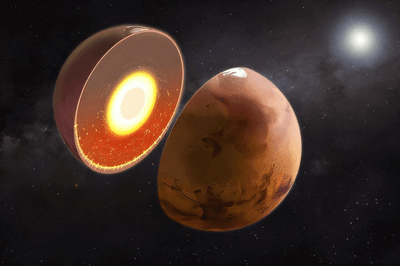


For decades, we have known that Mars is an odd planet. Its Northern Hemisphere is mostly characterized by lowlands, accounting for one-third of the whole surface. The rest, which comprises all of the Southern Hemisphere, is heavily cratered highlands. New measurements suggest that these differences are not only skin deep.
New work, combining decades' worth of data from Mars Global Surveyor, Mars Odyssey, and Mars Reconnaissance Orbiter, produces a precise map of the gravitational field of the Red Planet.
Due to its elliptical orbit and tilt, the gravitational pull that the Sun has on Mars varies with the season. These variations allowed the scientists to map the interior of the planet from orbit, and the results suggest that the Martian mantle in the south might be 200 to 400°C (360 to 720°F) hotter than in the north.
"Scientists usually assume that the interiors of planetary bodies are generally spherically symmetric, but this is not necessarily true," Dr Alexander Berne, from the University of Arizona, said in a statement.
"As we get more gravity data, we can determine the three-dimensional intricacies of a planet's interior structure. These inferences in turn give us a blueprint for designing future missions and scientific exploration of these worlds. Understanding the interior structure of planetary bodies helps us unravel the processes that shaped their formation and evolution."
The Martian dichotomy has been studied for a long time. The two hemispheres differ in elevation by 1 to 3 kilometers (0.6 to 2 miles), and the thickness of the crust is almost double in the south. It remains unclear what caused the dichotomy: a single impact, a series of cosmic collisions, or internal processes such as plate tectonics.
The difference in terrain, whatever the cause, certainly shaped ancient Mars, especially during the period when water was flowing on its surface.
The thermal difference might suggest that Mars had a much stronger magnetic field in the past, which led to magnetic differences in the two hemispheres and the temperature anomaly estimated in this work.
"The dichotomy that we see between north and south is important to understand because it gives information about processes that may have influenced the hydrology of Mars, including the formation of basins that may have held water," added Amirhossein Bagheri, a postdoctoral scholar at Caltech and co-author on the paper.
Bagheri was part of NASA's InSight mission, which measured marsquakes and helped provide our best understanding of the interior of Mars. InSight saw seismic waves dissipate more quickly in the Southern Hemisphere, which is consistent with a hotter mantle there.
The study is published in the journal Nature.