Space and Physics
 PUBLISHED



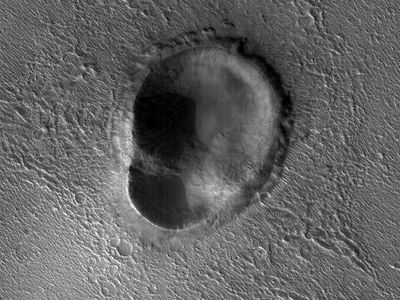


We are always finding stuff on Mars that looks like something else. From the famous face – that turned out to be a windswept hill – to snakeskin netting "shed" by Perseverance's landing gear. Now the Mars Reconnaissance Orbiter (MRO) has spotted another interesting feature. A crater that looks like an ear.
“Is it pareidolia, where we see features like faces and patterns where they do not really exist, if the shape really does resemble something? In this case, we’re looking at an odd-shaped impact crater that looks a great deal like an ear. And once you see it, it’s almost impossible to un-see. The crater is just over 1,800 meters across. This scene is located in Chryse Planitia in the Northern Hemisphere of Mars,” the MRO High-Resolution Camera team wrote in a blog post making this the picture of the day last Friday.
Chryse Planitia, where the 1.8-kilometer (1.1-mile) crater is located, is a fascinating region. It is one of the locations on Mars with the lowest altitudes, sitting 2 to 3 kilometers (1.2 to 1.9 miles) below the median elevation for the planet. This made the region a natural endpoint of many ancient rivers, including outflows channels from southern highlands and even from Valles Marineris.