Humans
 1
1


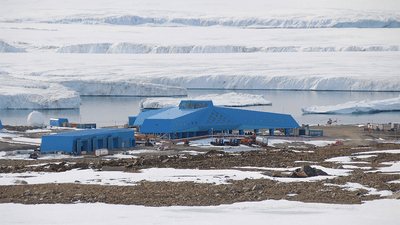


A researcher at the Jang Bogo Station in Antarctica has been evacuated and returned to South Korea after an incident involving a makeshift weapon.
According to officials at the Korea Polar Research Institute (KOPRI), the incident involved the use of a 30-centimeter (12-inch) blade, fashioned from a steel sheet in the South Korean research station in southeastern Antarctica.
"At approximately 7:20pm, local time, on April 13, a safety incident occurred at the Jang Bogo Science Station in Antarctica, where an overwintering research member threatened other members with a weapon," KOPRI told ABC in a statement.
"Upon recognition of the situation, the station leader and officials immediately separated [the man] from the rest of the team."
Getting people in and out of the continent during the long Antarctic winter is no trivial matter, and the man, in his 50s, was reportedly kept separated from the group for three weeks before he could be evacuated via plane.
Having been returned to South Korea, the man in question is now subject to a police investigation, with CCTV footage allegedly showing his colleagues fleeing as he walked through the station carrying the blade.
Researchers who remain at the base for the winter have since received psychological counseling, and ordinary operations continue.
Despite Antarctica being uninhabited aside from researchers interested in, for example, cosmic dust trapped in the ice, the continent has had its fair share of violent incidents.
In 1984, for example, at the Argentinian Almirante Brown Station on Coughtrey Peninsula, the station doctor was asked unexpectedly to stay overwinter, meaning that he would have to remain there until the ice had thinned as the continent headed towards summer.
In an effort to avoid this, or perhaps to make his feelings clearer than could be achieved with words, the doctor took the decision to burn the facility to the ground. The researchers all survived and were rescued by the USS Hero and moved to the US’s Palmer Station.
Others haven’t been so lucky. In 1996 at McMurdo Station, an ominous name for a home, even if the circumstances weren't so similar to the setting of The Shining, a galley cook took the much more direct approach of attacking another kitchen worker with the claw end of a hammer following an argument.
A third, more well-known, incident took place in 2018, when Sergey Savitsky was accused of stabbing welder Oleg Beloguzov several times in the chest. Savitsky and Beloguzov had reportedly not been getting on for the past six months, and there are a couple of different versions of what sparked the supposed attack.
According to one version, Beloguzov told Savitsky he should dance on the tabletop to earn some money, and in the other, Beloguzov allegedly spoiled the ending of whatever book Savitsky was reading, only justifying the attack in the eyes of the most hardened bookworms. Beloguzov was treated in Chile, and the case against Savitsky was eventually dropped, apparently on Beloguzov’s suggestion.
While there is little evidence for the book spoiler version of the story, it is believed that these kinds of incidents are more likely to be set off by seemingly minor inconveniences due to the extreme isolation of the Antarctic, as well as the complex tensions that arise after spending so much time with the same people, day after day, shut off from the rest of humanity.
In fact, there is even a term for it, "overwinter syndrome" or "winter-over syndrome," which describes the symptoms that can be triggered by staying too long in Antarctica.
"Absence of mind and confusion are part of the winter-over syndrome, an accumulation of symptoms typical of Antarctic expeditions. Most hibernators experience this syndrome in different forms," Carmen Possnig, who spent 12 months in the Concordia research station in Antarctica, explained in a European Space Agency blog post.
"It was first described by Frederic Cook in 1900. Cook was the doctor of the Belgian expedition, the first hibernation in Antarctica. Other symptoms include irritability, depression, difficulty concentrating, memory loss, insomnia, aggressiveness, and the occurrence of mild trance states (also called the “Antarctic stare”)."
On top of this, some researchers may suffer from "T3 syndrome," where their thyroid function is altered due to the extreme cold, often resulting in poorer moods as well as cognitive impairment, and reduced sleep and sleep quality may also play a part in deteriorating mental states.
Researchers are rather interested in the effects of this extreme isolation, as it could help them foresee difficulties that might arise during long, crewed space missions. One team found that overwinterers tended to become more emotionally flat and indifferent during their stays on the continent.
"This interpretation is consistent with early research which noted the occurrence of a mild psychological fugue state known as the Antarctic stare, around the third quarter of the stay," that team writes in their paper. "The phenomenon state is characterized by an altered state of consciousness or pronounced absentmindedness, “drifting,” wandering off attention, and deterioration in situational awareness."
However, the syndrome isn’t entirely unique to Antarctic stays, with participants in the MARS500 isolation study experiencing similar deterioration of cognitive function and one participant experiencing symptoms of dissociation.
All in all, though Antarctica does not have a permanent population, the effects of the environment and isolation mean it does get its fair share of incidents between colleagues trapped on the continent for long periods of time.
Prior to this case, the last incident took place in 2025, with allegations of physical assault, sexual harassment, and death threats at the South African-run SANAE IV research base in Vesleskarvet, Queen Maud Land, Antarctica.