Humans
 PUBLISHED


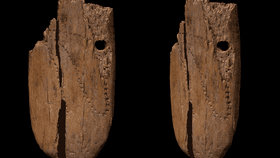


A broken ivory pendant found in a Polish cave has been dated as 41,500 years old, making it the oldest ivory jewelry from Eurasia. It is also the oldest example of an ornament decorated with puncture marks in a looping curve, which may represent an early tally sheet, like notches on a belt. If so, this would indicate the object could be the earliest indication we have found of mathematics or astronomy, a key turning point in human culture.
Several items made from mammoth tusks have been found in Europe and Asia that are marked with curving lines of holes. Although these may have been purely decorative, it is suspected they represented something much more significant for human development: counting. Suggestions include tallies of hunting success or an analemma marking the Moon's movements across the sky.
Unfortunately, however, most of these were found and moved when dating methods were less advanced – attempts to measure their ages have given contradictory answers. The discovery in 2010 of a pendant at Stajinia Cave in southern Poland provided an opportunity to change that. A study published in Scientific Reports places its timing close to the time when Homo Sapiens arrived in Europe and before reliable dates for anything similar.

“Determining the exact age of this jewelry was fundamental for its cultural attribution, and we are thrilled of the result,” said first author Professor Sahra Talamo of Bologna University in a statement.
The pendant was found with a horse bone awl (tool for punching holes), stone tools, and animal bones that could collectively add to our understanding of the culture that made it.
The cave was occupied by Neanderthals and modern humans at different times, but the researchers are confident who made the pendant and awl. “This piece of jewelry shows the great creativity and extraordinary manual skills of members of the group of Homo sapiens that occupied the site. The thickness of the plate is about 3.7 millimetres showing an astonishing precision on carving the punctures and the two holes for wearing it,” said co-author Dr Wioletta Nowaczewska of Wroc?aw University.
The location where the pendant was found could be almost as significant as its age. Very few indications of human occupation have been found from Poland for several thousand years after the last Neanderthals disappeared there. The discovery of these items puts to rest any possibility there was a delay between Homo Sapiens occupying western Europe and Poland.
Markings like these have been found on items from Germany and south-western France – a vast distance from Poland when all travel was on foot. Ten thousand years later, similar things turned up in northern Siberia.
“If the Stajnia pendant’s looping curve indicates a lunar analemma or kill scores will remain an open question. However, it is fascinating that similar decorations appeared independently across Europe,” said co-author Professor Adam Nadachowski of the Polish Academy of Sciences.