Space and Physics
 PUBLISHED


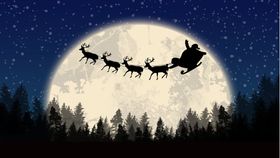


With impeccable timing, as usual, the International Space Station (ISS) will be making its annual appearance in the Christmas night sky tomorrow, allowing parents to show their kids “proof” that Santa is real as he whizzes past on his busy mission.
Unlike the jolly fat man though, the ISS doesn’t show up just once a year in the holidays to help us get In the festive spirit, it actually circles Earth 15 times a day – that’s a full orbit every 92 minutes. However each orbit covers a different part of Earth, so not everyone's lucky enough to get the well-timed festive appearance.
This year the UK’s sighting will appear tomorrow, Wednesday, December 20, in the afternoon, while the US gets not one but two sightings, again, tomorrow and also on Christmas Eve.
The ISS is scheduled to fly over the UK tomorrow and will be visible for around 3 minutes between 4.39pm and 4.41pm GMT, according to NASA, appearing as a bright streak zooming across the sky.
In the US, it will be visible traveling from the southwest to the southeast, around 5pm ET. Lucky viewers up early on Christmas Eve will also get another chance to spot space Santa as the ISS should be visible at 6.30am ET.
For more specific times and locations, you can track the ISS and find out what time exactly it is due to cross your path with NASA's Spot the Station tool.
The ISS may be hard to spot at first but there are a few clues to help you single it out. It will appear as a constant bright light – no flashing or twinkling – as the Sun reflects off the satellite’s surface. It’s also very fast (but then Santa does have rather a lot to do in very little time) and always starts in the western part of the sky. Meteorwatch has a handy guide for other things to look out for.
The station orbits 408 kilometers (253 miles) above Earth, traveling around 28,160 kilometers per hour (17,500 miles per hour). It's also now back up to six crew members, after three new members arrived safely this morning just in time for Christmas, so don't forget to give them a wave too.