Space and Physics
 PUBLISHED



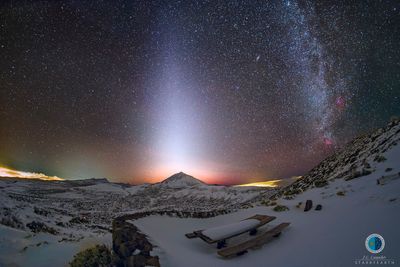


The space between planets is not clean and pristine, despite being an excellent vacuum. It has dust, and this dust often catches sunlight creating a faint glow that permeates interplanetary space. The ghostly glow appears visible from Earth as a hazy triangle of light known as "zodiacal light", and the best time to see it is after dusk right now.
From now until the equinox on March 21, if you are in mid-latitudes and with a dark sky after the Sun has set, you will see the tell-tale triangular glow in the west. It's called zodiacal light because it is brightest along the band of zodiac constellations straddling the ecliptic plane, the pathway of the Moon and Sun as they appear to move across the sky.
The best conditions to see the zodiacal light is sunset and sunrise around the spring and fall equinoxes, when the ecliptic makes its most extreme angles with the horizon. Due to the orientation of the Earth’s axis, during the Northern Hemisphere's spring, it is easier to see after dusk. In the fall, you'll be able to see it before dawn.

Right now, if you look west, the zodiacal light will be framed by two planets that were only last week in conjunction: Venus and Jupiter. The source of zodiacal dust comes from shedding comets influenced by Jupiter's gravity, such as 67P/Churyumov-Gerasimenko, visited by the European Space Agency's Rosetta mission. Another contributor in the inner Solar System appears to be Mars.
Zodiacal light is also known as false dawn in the Northern Hemisphere, and false dusk in the Southern. It was described by Mesoamerican people as well as by Muslim scholars and the prophet Muhammad long before it appeared in print in the west. Interestingly, zodiacal light is also the research topic of Dr Brian May’s thesis. He took a 36-year-long break before completing it because he became somewhat busy with his band, Queen.