Space and Physics
 PUBLISHED

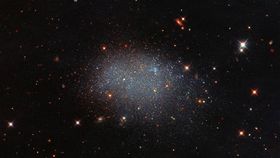


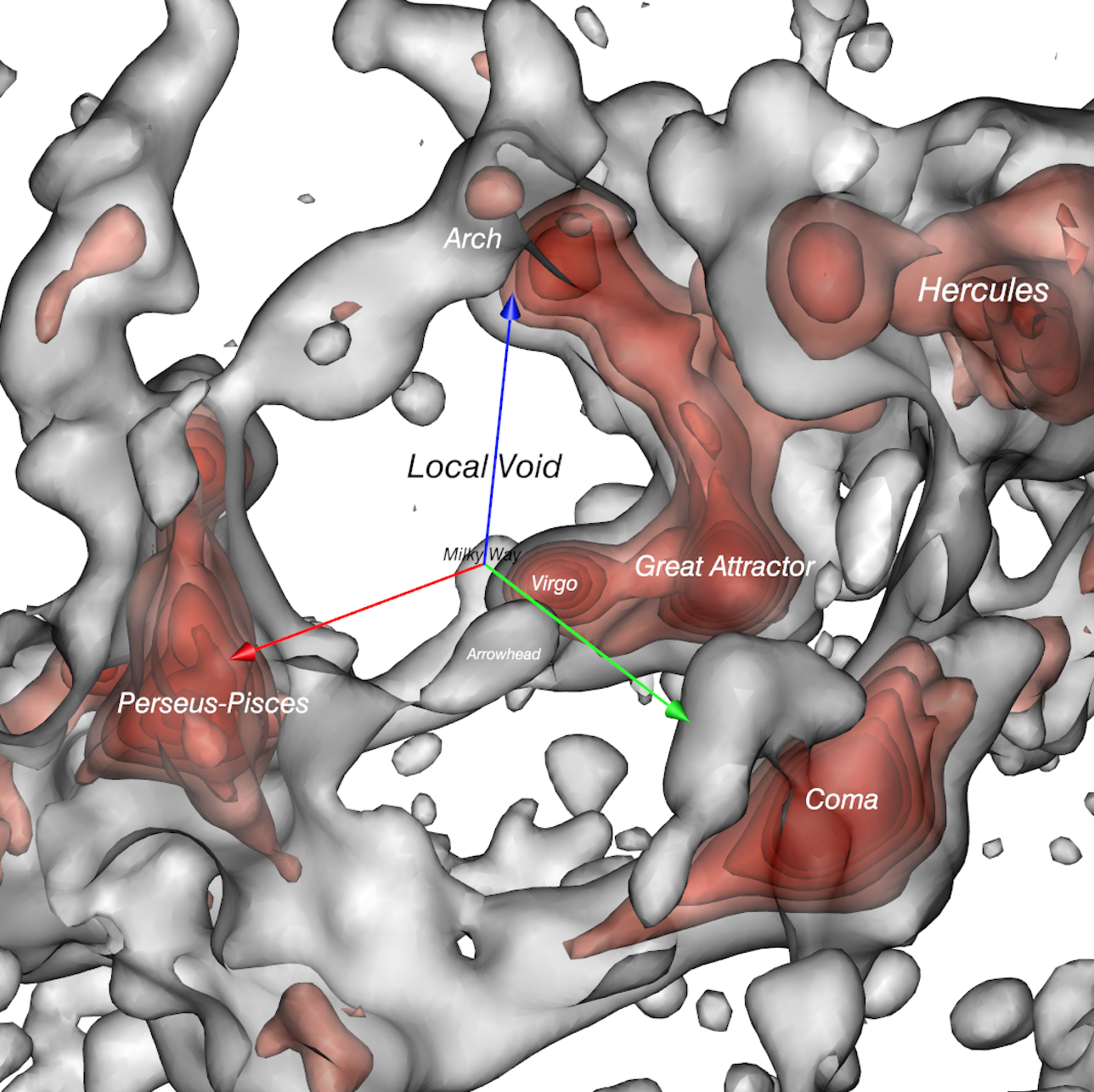
The majority of galaxies in the universe exist in clusters and groups organized in a structure known as the cosmic web. Indeed, our galaxy, the Milky Way, is part of the Local Group that in turn is part of the larger family of galaxies known as the Virgo Supercluster. But between the strands and nodes of the cosmic web lies vast low-density regions of space known as cosmic voids.
Our nearest void, the Local Void, begins 4 million light-years away from the other side of the Milky Way. Estimated to measure 150 million light-years across, this void is over a thousand times wider than our galaxy. These colossal areas of emptiness are thought to contain very few or no galaxies, but in the Local Void, one lonely galaxy is known for certain to occupy this enormous volume.
KK 246, or ESO 461-036, is a dwarf irregular galaxy with an extremely extended hydrogen disk. With no known neighbors within 10 million light-years of the galaxy, KK 246 definitely got the physical distancing memo. Although the image looks like there are nearer galaxies, they are actually from beyond the void and exist in other galaxy groups and clusters.
In the immense nothingness of the Local Void, 15 other galaxies have been tentatively identified, but the 23 million-light-year-away KK 246 galaxy remains the only one to be definitely placed in this peculiar location. This isolation has meant that KK 246 has not lost its gas to larger galaxies (like other Dwarf galaxies do) so it can give birth to new stars. In the image, these star-forming regions look like blue patches of “glitter” strewn across a black velvet background.
Despite its distance from us, KK 246 can still influence the motion of the Milky Way and our fellow Local Group galaxy, Andromeda. A study last year discovered that the gravitational push and pull of the surrounding emptier regions (the Local Void) and denser regions (the Virgo Supercluster) respectively accounted for 50 percent of the galaxies’ roughly 600 kilometers per second (1.3 million miles per hour) deviation.