


 Space and Physics
 PUBLISHED



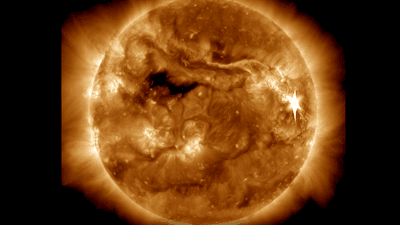


Last week, the Sun released the strongest flare yet of this cycle and the strongest in six years. It was an X 2.8 class flare, the strongest recorded since September 10, 2017, and about 5 to 10 percent of the strongest on record from November 2003. The Sun is approaching its maximum activity for its current solar cycle, Cycle 25. And we will be seeing a lot more energetic events from here on out.
Solar flares can create radio blackouts. The flares release powerful light in the form of X-rays and ultraviolet light that ionizes deeper, denser layers of the ionosphere around our planet. The light strips atoms in the atmosphere of electrons, leading to radio waves losing a lot more energy with all those free electrons around. The light from the recent flares reached Earth just eight minutes after the release on December 14, at 5:02 pm UTC.
The portion of our planet facing the Sun at that time was across the Americas. The effects were strongest in South America, but there were reports of radio communication interference over the United States. From the US, Thomas Ashcraft was able to record it from the Heliotown Observatory.
“This audio specimen was recorded December 14, 2023, at [5.05 pm] UT during the onset of an X 2.8 solar flare. It exhibits what are known as Type II solar emissions, also known as 'slow drift bursts'. The audio was recorded using two separate shortwave radios, one tuned to 22.2 MHz [megahertz] and the other tuned to 21.1 MHz. If you listen close, preferably with headphones, you will be able to hear the emissions slowly drift down in frequency, first passing through 22 MHz and then 21 MHz,” Ashcraft told IFLScience.
During a Type II solar emission, its radio frequency shifts, moving from high frequencies to low frequencies of around 1 MHz per second, and it exhibits two bands of emission. The recent powerful flare was preceded by a weaker M-class one originating from the same sunspot. It did not cause a blackout, but there was moderate interference across the sunlit portion of the Earth, which at that point was Europe, Africa, and parts of Asia.
A solar cycle lasts 11 years, going from a minimum of activity to a maximum. The current cycle is expected to peak between January and October of 2024, so more flares, more aurorae, and more blackouts are to be expected.


