Space and Physics
 PUBLISHED
 1
1



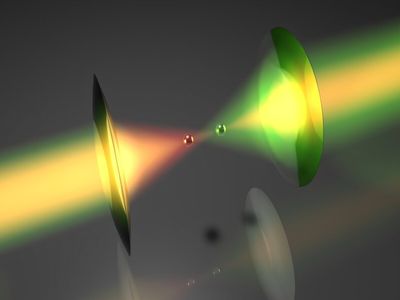


Quantum mechanics underpins all of reality, but at our level – the so-called classical world – we wouldn’t be able to tell. The difference is so stark that it seems like separate dimensions. The frontier between the two is difficult to explore, as objects and interactions can end up being more easily explained one way or another. However, researchers have now used a setup that sounds like something out of sci-fi to conduct simultaneous observations of classical and quantum phenomena.
Tractor beams using light or sound have existed for a while. Lasers can be used to create optical tweezers, a development that got Arthur Ashkin a Nobel prize in 2018 – so it is possible to move and trap little objects using light.
The target of the new experiment was two electrically charged glass nanospheres; they were trapped using lasers of different colors. Different colors mean different frequencies, so these spherules oscillate about very specific equilibrium points dictated by the lasers. The electric charge forces them to influence each other and the whole setup has a mixture of classical and quantum behaviors, which need to be accounted for to fully understand what’s going on.
"These nano-oscillators are among the rare systems in which we can investigate the behavior of macroscopic objects in a highly controlled manner," lead author Francesco Marin, from the University of Florence and the National Institute of Optics of the National Research Council (CNR-INO), said in a statement.
"The spheres are electrically charged and interact with each other, so the trajectory followed by one sphere is strongly dependent on the other. This opens the way for the study of collectively interacting nanosystems in both the classical and quantum regimes, thus allowing the experimental exploration of the subtle boundary between these two worlds."
Using the lasers, the two spheres were placed just 9 microns apart. A tiny distance, but enough for all the interesting interactions to come out to play. The two nanospheres were coupled due to their electric charge and could move along the tweezer axis; they are a very intriguing oscillating system.
The team believes that this experimental setup could vastly expand our understanding of strongly coupled oscillators in the classical and quantum realms. This might also have consequences in improving lasers and other devices that use optical cavities in their systems.
The study is published in the journal Optica.