Humans
 PUBLISHED




Archaeologists have found the remains of an ancient Mexican temple that was thought to be little more than a legend.
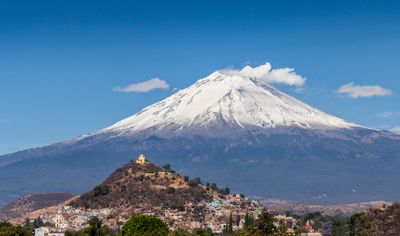
Within the city of Atlixco in central Mexico, there has long been a rumor of a lost temple, or teocalli, that was built centuries before the Spanish arrived in the early 16th century. According to the local people, the Atlixquenses, the temple was originally constructed on top of the San Miguel Hill where there is currently a Catholic chapel dedicated to the archangel Michael.
Despite these rumors, no archaeological evidence for this legendary temple had ever been found. However, recent work carried out by the Ministry of Culture of the Government of Mexico through the National Institute of Anthropology and History (INAH) has discovered vestiges that confirm its existence.
The first evidence that led to this discovery appeared during efforts to renew the chapel’s lighting and to reinforce the paths leading up the hill. A team of researchers, coordinated by INAH archaeologists Miguel Medina Jaen and Carlos Cedillo Ortego, along with Elvia Cristina Sánchez de la Barquera, found artifacts – stone tools, ornaments, and clay vessels – that were over 1,000 years old. These objects were created by the Mesoamerican Nahua, who lived in this region centuries before Europeans arrived.
The team carried out survey work inside and around the chapel’s atrium and found the remains of stone walls and floors that had belonged to an ancient temple that pre-dates the current structure. These remnants are buried around 90 centimeters (35 inches) below the foundations of the existing chapel.
This, according to a statement released by the INAH, sufficiently affirms that “a teocalli did exist on the summit of the hill, San Miguel, and that it had at least two construction stages.”
At present, it is not clear which divinity the temple was dedicated to. Among those who may have been the focus of attention were the deities Quetzalcóatl (creator and civilizer of humanity), Tláloc (giver of rain), or Macuilxóchitl (a patron of play, dance, and festivities).
However, more research is needed before any valid conclusions can be drawn. Other “segments of the teocalli and greater clues to clarify which was its titular deity still lie under the viceregal chapel of San Miguel Arcángel,” the statement adds.
“Even with this aura of mystery, the archaeological confirmation of that ancient popular belief of more than 400 years will help strengthen the identity of the Atlixquenses.”