Culture and Society
 PUBLISHED


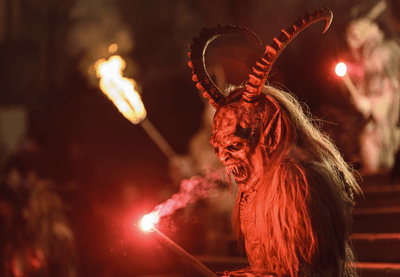


Each year in early December, American internet users become bewildered by the sight of people parading down an Alpine street, dressed to the nines in beast-like costumes and ghoulish masks, waving flamed torches and beating drums. Fear not, the Europeans have not declined into devil worship – this is an age-old tradition steeped in folklore.
Krampusnacht, meaning "Krampus Night", is celebrated in Alpine regions of Central Europe, namely around southern Germany, the Czech Republic, Austria, Liechtenstein, and northern Italy. It centers around the character of Krampus, a half-goat, half-man creature with devilish horns, often described as the dark, mischievous counterpart to St. Nicholas, the patron saint of children.
“He’s a hairy creature with goat horns, cloven hooves, and a lolling tongue, and he’s weighed down with rusty chains and bells. He carries a birch stick to strike naughty children and a sack to carry the very worst ones away. If you leave some Schnapps out for him, he might be kinder to you,” Deborah Hyde, a cultural anthropologist with an interest in folklore, told IFLScience in 2022.
When Is Krampusnacht?
Krampusnacht takes place annually on the night of December 5, the eve of the Feast of St. Nicholas, when the saint traditionally rewards well-behaved children with presents. Those who haven’t been so good, however, can expect a visit from Krampus, a terrifying figure who arrives the night before to dish out punishment with birch rods or other frightful reprimands.
In days gone by, the night often featured a Krampuslauf, or “Krampus run,” in which people dressed as the horned creature would chase shrieking children through the streets, threatening mock punishment. These days, things are a touch more tame. Modern Krampus events lean more toward raucous street parades with elaborately carved wooden masks, shaggy fur suits, flames, ringing cowbells, and a lot of theatrical growling.
History of Krampusnacht
The origins of Krampusnacht can be found deep in the pre-Christian past of Europe, drawing on influences of paganism and Norse mythology. When Christianity later became dominant in Central Europe, attitudes toward Krampus soured. To many at the time, his devilish appearance seemed to embody what they perceived as the “wild” and “uncivilized” practices of pagan culture, very much at odds with the squeaky clean traditions of the Church.
Nevertheless, the character of Krampus was deeply embedded in the culture of the masses and refused to leave quietly.
“With the arrival of Christianity, St Nicholas became the focus of winter festivities. Krampus was successfully absorbed as a less kindly counterpart. The written records only go back a few hundred years, but many folklorists think Krampus originates from much earlier," explained Hyde.
The idea of Krampusnacht may seem alien to outsiders, especially people in North America who are less in touch with niche corners of European folklore, but it may be more familiar than you first think. It’s worth remembering that some aspects of Krampus are interwoven into our modern conception of St. Nicholas, aka Santa Claus or Father Christmas.
“Krampus may have absorbed elements of the god Odin, who was associated with the Germanic pagan midwinter event of Yule and who led the Wild Hunt, a ghostly procession through the sky. It’s worth remembering that our Father Christmas rides on a sleigh through the air," said Hyde.