Space and Physics
 PUBLISHED
 1
1



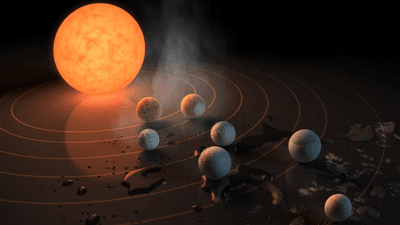


The TRAPPIST-1 system is made of a cool, small star and seven planets orbiting in a matter of days. All the planets have a size not dissimilar to Earth or Venus, and being relatively close to us makes this system an intriguing candidate for atmospheric searches with JWST, a crucial stepping stone to the investigation of their habitability. The observations so far are not really showing major atmospheric structures.
The latest result focuses on TRAPPIST-1 c, the second closest planet to the star. Just like TRAPPIST-1 b, the planet receives a lot more light than the Earth does. TRAPPIST-1 c is similar to Venus in terms of the amount of radiation it gets but is about 60 percent more massive. The team hoped that like Venus, it had been able to retain a thick atmosphere. But they found that, at most, it has a tenuous carbon dioxide atmosphere, although it might not have one at all.
The results are not surprising. The TRAPPIST-1 star is slightly larger than Jupiter and has a mass of about 9 percent that of the Sun, with a temperature of 2,293 °C (4,160 °F) – the coldest star known to host planets. But do not let this fool you. These cool stars are very active with flares and powerful stellar winds that can strip a planet of its atmosphere.
“We wanted to find out if TRAPPIST-1 c may have escaped that fate and could have retained a substantial atmosphere, and perhaps even be similar to the planet Venus in the Solar System,” lead author Sebastian Zieba, a graduate researcher at the Max Planck Institute for Astronomy (MPIA), said in a statement.
“We can definitely rule out a thick and Venus-like atmosphere,” added Laura Kreidberg, the lead scientist of the JWST observing program and a co-author and Director at MPIA.
So far, they can for sure rule out a thick atmosphere, but their models very widely allow an atmosphere rich in carbon dioxide and oxygen from 1 percent to 100 percent of Earth’s sea level pressure. More data is required. While JWST is the most powerful space observatory ever launched, studying small exoplanets and their atmosphere is very difficult.
“Observations of thin rocky-planet atmospheres push JWST to its limits,” Kreidberg explained.
But there are five more planets to get results on, with maybe four of them – d, e, f, and g – in the habitable zone of the star where liquid water might exist.
“The nearby TRAPPIST-1 planetary system is currently the best candidate to study the atmospheres of rocky, Earth-like planets orbiting a red dwarf star,” Zieba stated.
The findings are published in Nature.