Space and Physics
 PUBLISHED



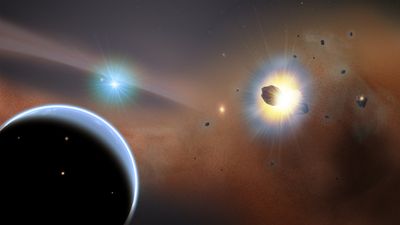


Twenty years ago, astronomers used the Spitzer telescope to study Beta Pictoris, a star 63 light-years away. Researchers back then saw a significant amount of dust, shining in infrared. Using Spitzer's successor, JWST, astronomers looked for the same dust and discovered something exciting: The dust was gone.
The research team believe that the dust was pushed away by the radiation of the young star. This motion also allowed for the dust to cool off, and it is no longer detectable. If dust can just be swept away, it means that is not standard and constant feature. Something must have caused it, and the astronomers had a very exciting explanation: Asteroid collision.
The Beta Pictoris system is young, around 20 million years old. The collision is likely the results of planetesimals colliding on their way to form planets – planets that might one day be like Earth, or Mars, or Venus.
“Beta Pictoris is at an age when planet formation in the terrestrial planet zone is still ongoing through giant asteroid collisions, so what we could be seeing here is basically how rocky planets and other bodies are forming in real time,” lead author Christine Chen, a Johns Hopkins University astronomer, said in a statement.

The team believes that the collision released an enormous amount of dust, equivalent to about 100,000 times the asteroid that brought an end to the non-avian dinosaurs. Beta Pictoris has two gas giant planets that have already formed, but no known terrestrial planets yet.
“The question we are trying to contextualize is whether this whole process of terrestrial and giant planet formation is common or rare, and the even more basic question: Are planetary systems like the solar system that rare?” said co-author Kadin Worthen, a doctoral student in astrophysics at Johns Hopkins. “We’re basically trying to understand how weird or average we are.”
JWST's fantastic ability to see the infrared universe has once again delivered incredible insights into astronomy. Although this was sort of by omission.
“Most discoveries by JWST come from things the telescope has detected directly,” said co-author Cicero Lu, a former Johns Hopkins doctoral student in astrophysics. “In this case, the story is a little different because our results come from what JWST did not see.”
The research was presented by Chen at the 244th Meeting of the American Astronomical Society in Madison, Wisconsin.