Space and Physics
 PUBLISHED
 13
13



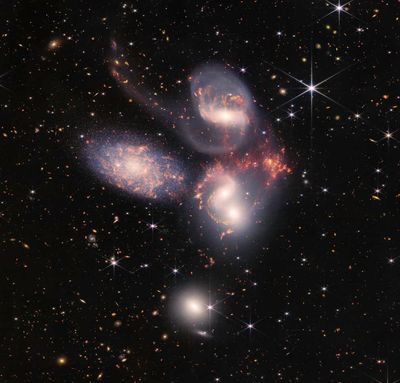


JWST was able to determine the composition of the gas around the supermassive black hole of NGC 7319, one of the five galaxies of Stephan’s Quintet. This was one of the first scientific targets of the telescope, which observed the gas in this active galaxy core in wavelengths that have never been detected before.
With its near-infrared instrument, it was able to see atomic hydrogen and molecule hydrogen, which is formed when two hydrogen atoms bond together. It also saw iron ions. This is an excellent tracer for where the hot gas is located around the supermassive black hole. Even though black holes don’t emit light, when they feed like this one, they are messy eaters. The intense gravity heats up the material they are snacking on creating intense radiation.

The supermassive black hole at the center of NGC 7319 has a mass equivalent to 24 million times that of our Sun or about six times Sagittarius A*, which sits at the center of the Milky Way. But unlike Sagittarius A*, this supermassive black hole has a stupendous emission of radiation – like 40 billion Suns were shining at once.
Hydrogen and iron are not the only things that JWST was able to observe. In its mid-Infrared observations, the telescope saw an outflow of hot gas that contained hot, ionized gases, including iron, argon, neon, sulfur, and oxygen. And the immediate area around the black hole is rich in hydrogen as well as silicate dust – like grains of sand, but a lot smaller.

JWST also observed the movement and the velocity of the gas. Just like an ambulance's siren has a higher pitch as it comes towards you, the wavelength of electromagnetic radiation of light-emitting objects shifts as it moves towards or away from you. So the telescope could tell how the gas was moving and how fast.

Studying supermassive black holes in nearby galaxies allows us to understand them anywhere in the Universe. Stephan’s Quintet is made up of four galaxies in a compact group and one that appears to be close to them but only visually. The group is located 290 million light-years away from Earth.
JWST's photo of the group has 150 million pixels and was constructed from almost 1,000 separate image files. The telescope could see individual stars and the bright core of NGC 7320, which is the closest (and leftmost) in the group.