Space and Physics
 PUBLISHED


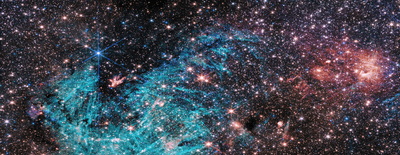


JWST has gazed deep into the heart of our Milky Way galaxy and spotted some never-before-seen features that astronomers are yet to fully understand.
The image shows Sagittarius C, a star-forming region located around 300 light-years from the supermassive black hole at the center of the Milky Way, Sagittarius A*. This is relatively close to the galactic center and provides the stage for some especially exciting star formation activity.
“The galactic center is a crowded, tumultuous place. There are turbulent, magnetized gas clouds that are forming stars, which then impact the surrounding gas with their outflowing winds, jets, and radiation. Webb has provided us with a ton of data on this extreme environment, and we are just starting to dig into it,” Rubén Fedriani, a co-investigator of the project at the Instituto Astrofísica de Andalucía in Spain, said in a statement.
Captured by JWST’s NIRCam (Near-Infrared Camera), the image shows a cluster of approximately 500,000 stars and protostars that are forming and glowing against the backdrop of violent infrared-dark clouds. In the middle of the cluster, we can see a massive protostar over 30 times the mass of our Sun.
The darker patches of the image might initially seem less crowded with stars and protostars, but the opposite is true; these are the most crowded parts of the image. It only appears less busy because the cloud surrounding the protostars is so dense that the light from the stars behind it cannot reach JWST.
.png "The full version of the newly released image of Sagittarius C in the Milky Way.")
The strangest feature of the image is the cyan-colored feature surrounding the lower side of the dark cloud. As explained by the researchers, you’d typically expect this to be produced by energetic photons being emitted by young massive stars, but they suspect that JWST has picked up on something more significant, which they’re keen to investigate.
The team also wants to look further into the needle-like structures in the ionized hydrogen that chaotically appear in the cyan-color haze.
“There’s never been any infrared data on this region with the level of resolution and sensitivity we get with Webb, so we are seeing lots of features here for the first time. Webb reveals an incredible amount of detail, allowing us to study star formation in this sort of environment in a way that wasn’t possible previously,” explained Samuel Crowe, the observation team’s principal investigator and undergraduate student at the University of Virginia in Charlottesville.
“The image from Webb is stunning, and the science we will get from it is even better. Massive stars are factories that produce heavy elements in their nuclear cores, so understanding them better is like learning the origin story of much of the universe,” he added.