Humans
 PUBLISHED


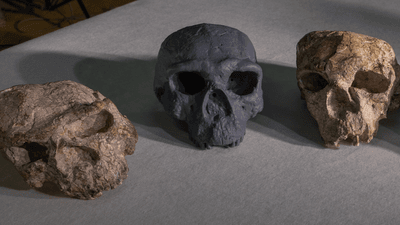


Human evolution is a fiddly business, and few fossils encapsulate that more than two skulls unearthed in Hubei Province, China, in 1989 and 1990. Both are relatively intact, but their long burial at the mouth of the Quyuan River has left them somewhat flattened, making it difficult to tell which of our ancient relatives they might have belonged to.
In other cases, this uncertainty might just cause some academic quibbling, but here, two conflicting views imply very different things about the geography and timing of our species’ evolution. First though, it pays to take a few steps back and consider what we think we know about our own prehistory.
The dominant view among researchers is that the cradle of hominin evolution is Africa, and hominins – the group that includes our closest relatives – left the continent and spread out across Eurasia several times throughout prehistory.
The first of these was Homo erectus, the earliest member of our genus to walk fully upright, which fossil evidence suggests reached Eurasia as early as 1.8 million years ago (though there is some debate about exactly what these remains represent).
Then around 600,000 years ago (the numbers here are also somewhat flexible), another group headed out from Africa, spread into Eurasia and eventually diverged into two distinct populations: the Neanderthals, which became established across Europe and western Asia, and the Denisovans, a more recently identified group, whose range appears to have extended from Siberia to Southeast Asia.
Finally, based on the oldest fossils we have found, it would appear H. sapiens emerged in Africa some 300,000 years ago and spread out across the other continents much more recently, eventually becoming the only hominin lineage to survive to the present day.
So, how do the Yunxian skulls fit into this? Well, they have traditionally been ascribed an age of just over a million years old, so based on that, you would expect the only possible answer to be that they belong to some sort of H. erectus. Case closed, then?
Would that it could be so simple. Previous analyses of the Yunxian skulls found they had a surprisingly large cranial volume, one that was quite atypical for H. erectus. They also lack key features, such as thickened bone in parts of the skull, that would mark them clearly as belonging to that species.
For those who say that the Yunxian fossils belong to Homo erectus, what are the diagnostic features that demonstrate that?
Professor Chris Stringer
One such missing feature is a thickened sagittal keel, essentially a crest that runs along the top of the skull for the attachment of stronger jaw muscles. This feature is usually seen in H. erectus, including in the Peking Man fossil found in Beijing that has been dated to around 700,000 years ago, but it appears to be absent from the Yunxian fossils.
As Professor Chris Stringer at London’s Natural History Museum told IFLScience: “For those who say that the Yunxian fossils belong to Homo erectus, what are the diagnostic features that demonstrate that?”
This has led to some researchers believing that the Yunxian skulls aren’t examples of H. erectus at all, and it was onto this background of uncertainty that a research group co-led by Stringer dropped a bombshell in September last year.
By reconstructing the Yunxian II cranium using modern CT scanning and the digital sculpting tool Z-brush, then comparing the resulting model to 56 other hominin fossils, the researchers concluded that it instead belongs right at the start of the Denisovan lineage.
This would make it much more modern than H. erectus and the oldest known Denisovan fossil by a considerable margin. The results also led the researchers to propose a new family tree – one that looks very different from the picture painted by genetics.
Where DNA evidence puts the split between our lineage and the Denisovans at around 600,000 years ago, this tree pushes that date back to about 1.3 million years ago and backdates the split from Neanderthals to nearly 1.4 million years ago. It also suggests that Denisovans, not Neanderthals, are our closest extinct relatives.
“Of course, we acknowledge that our phylogenetic results [the reconstructed family tree] are in conflict with the standard genetic model of relationships,” said Stringer. “But our geometric morphometric analyses, which look purely at the shapes of the skulls, independent of age and supposed taxonomy, clearly show Yunxian as different from erectus, and closer to the later Chinese crania.”
As with any piece of research that has such wide-ranging implications, other specialists have expressed some caution about how to interpret the results.
Speaking to BBC News in September, Dr Aylwyn Scally, an evolutionary geneticist at the University of Cambridge, said: “One has to be particularly tentative about the timing estimates, because those are very difficult to do, regardless of what evidence you're looking at, be that genetic or fossil evidence.”
There is also the fact that, when making a reconstruction, there is always going to be some room for interpretation when it comes to exactly how it gets put together.
For example, when Dr Amelie Vialet, a palaeoanthropologist at the National Museum of Natural History in Paris, led a reconstruction of the same skull in 2005, her team concluded it had a flatter forehead than Stringer’s group suggests, and so came to a somewhat smaller cranial volume (about 100 milliliters less) than the one given in the new study.
“In the case of these fossils,” Vialet told IFLScience, “they are largely flattened artificially, but since they are archaic forms, these skulls are morphologically flatter than those of modern humans. In other words, during the reconstruction process, how do we know where to stop when trying to correct this artificial flattening? It's a difficult question.”
Stringer highlights that his team made a total of six reconstructions, two sets of three that were produced independently by two different researchers. He also pointed out that techniques have moved on in the years since Vialet’s work, so he is more confident in his own group’s findings.
Disagreements all the way down
Now there has been a further twist. A new analysis of the age of the Yunxian site has concluded that the two skulls may be considerably older than previously thought – closer to 1.8 million years old rather than just over a million.
"That million-year age came from correlating the fossilized fauna with other sites like Gongwangling, which used to be considered the most securely dated site in Asia at 1.15 million years," Dr Darryl Granger at Purdue University, who worked on the new study, told IFLScience. "Then in 2015, they showed there was a missing piece of sediment in that section."
That matters because both the Gongwangling site and the Yunxian site had been dated using palaeomagnetism, a technique that tracks the number of times Earth's magnetic field has swapped polarity over time. The problem is that every reversal looks identical, so you need to know how many layers there are in total to make an age estimate.
"With palaeomagnetism, you can identify when the polarity changes, and you know those changes happened at certain times in the past," said Granger. "The trick is knowing which transition you're looking at. So, what you do is combine the palaeomagnetism with another dating method.”
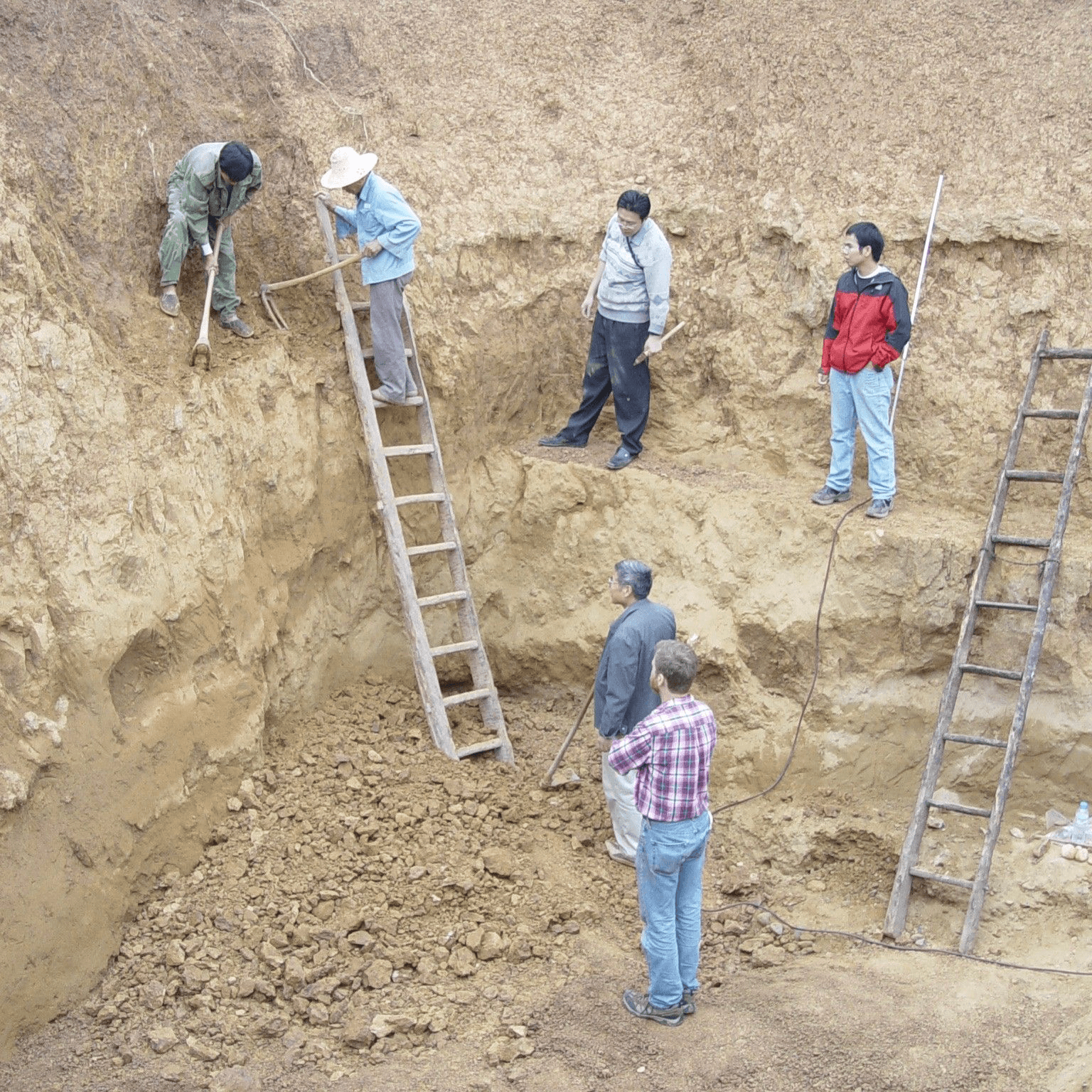
That’s what Granger, Christopher Bae at the University of Hawaii, and their colleagues, including Hua Tu at Shantou University, did using a technique called cosmogenic nuclide dating, which measures the passage of time based on the effects that solar radiation has on elements in the earth.
“What our new result shows is that they had identified the wrong reversal [at Yunxian],” said Granger. “Our dates are fully consistent with the palaeomagnetism, but they indicate we're looking at a magnetic reversal at around 1.8 million years rather than 1.1 million years."
If the new figure is correct, the skulls are simply too ancient to be Denisovans, and it would seem the H. erectus interpretation has gotten a bit more heft. So, the big question is, how confident can we be that this new age estimate is correct?
Vialet thinks it could be – though with some reservations: “[Cosmogenic nuclide dating] consistently yields older dates than other methods used on the same sites,” she said. “However, the fauna did not change significantly between 1.77 and 1 million years ago, so the older date is consistent with the fauna.”
Stringer is more doubtful, and in an email to IFLScience, he brought up the fact that the samples used in the new dating study were taken 75 meters (246 feet) away from where the Yunxian skulls were found, which he suggested could mean they are from an older terrace of the river and don’t reflect the age of the fossils.
When IFLScience presented this to Granger, he agreed it was unfortunate they couldn’t perform their dating at the original site, which they didn’t have permission to re-excavate. He also acknowledged that the dating of hominin sites in China is particularly difficult because there are no widespread volcanic ash deposits that could be used for more direct dating.
Despite this, both he and Bae are confident in the method they used and that the layer they dated corresponds to the one in which the fossils were buried, partly because it contains distinctive mineral deposits and worked stones. The method they used also allowed them to calculate the depth at which sediment was buried, and this lined up with the measured depth, which Granger said validates their approach and provides a “good gut-check” on whether or not their results are correct.
Stringer’s final contention with the new date is simply based on the size of the Yunxian crania, which would be rather unusual for the time period, whether going by his own group’s estimate or the earlier one by Vialet.
“It would indeed be remarkable if the large-brained Yunxian 2 fossil was nearly 1.8 million years old, putting it close in age to small-brained crania like Dmanisi and 3733, even though its brain volume is about double the size of some of them,” he told IFLScience. “In fact, at about 1,140 ml, I think Yunxian has the largest estimated cranial capacity of any fossil at about 1 million years, let alone at 1.77!”
So, as mentioned at the top of this article, it’s all rather fiddly. But there is potentially a light at the end of the tunnel that could lay some of these arguments to rest. A third skull, reportedly with less deformation than Yunxian II, was found 35 meters (115 feet) from the site at which the other two were uncovered.
In an email to IFLScience, Vialet said that she had had the opportunity to see the skull, and noted that “its forehead is flattened”, potentially marking it as closer to H. erectus. But we’ll have to wait for a formal analysis before that can be confirmed, and to see what effect it has on the wider debate about these inscrutable skulls.
The new study is published in the journal Science Advances.



 8
8