Humans
 PUBLISHED
 1
1


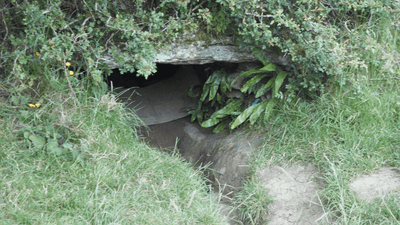


A cave in Ireland’s County Roscommon is believed to be the site of some seriously spooky goings on. Oweynagat cave, also known as the Cave of the Cats, is said to be Ireland’s "Gate To Hell", a place that acted as a portal to the otherworld each year on October 31.
That belief dates back around 2,000 years, and as local archaeologist and historian Dr Daniel Curley to the BBC, the transitional period between autumn and winter brought with it a host of unusual, otherworldly characters.
“Monsters and manifestations would emerge, led by the goddess Morríghan, to create a world ready for winter, including birds with foul breath that would strip leaves from trees. Locals would stay indoors in fear of being dragged into the other world when the ghouls had finished ravaging the land," Curley explained. "If you had to go outside you wore a costume and mask to look hideous. That way you would be left alone and not dragged into the otherworld."
Dressing up as scary creatures and heading out at night – sounds familiar, right? And some believe that the Cave of the Cats could be the birthplace of Halloween.
The pre-Christian festival of Samhain (pronounced SAH-win) was held at Rathcroghan, the Ancient Capital of Connacht where the Cave of the Cats is found. It’s now the largest unexcavated Royal Site in Europe, with over 240 archaeological sites spanning 5,500 years of human history – from the New Stone Age through to the late medieval period. It’s also home to 28 burial mounds dating back to the Bronze and Iron Ages and is described in medieval literature as one of Ireland’s three key burial sites.
Oweynagat, also known as the “cave of Cruachan”, is one of the notable sites at Rathcroghan, not for its size or karst, but for its archaeological history.
“It was regarded a malevolent hell-like place full of terrifying mythical creatures and supernatural beings,” explained Joe Fenwick and Matthew Parks in the journal Irish Speleology. “In the metrical Dindschenchas the cave is described as the residence of the Morríghan, a pre-Christian goddess of war. Other early texts associate it with sinister and savage pigs, birds, cats and female werewolves. It is a place to be feared, particularly on the eve of Samhain when the hosts of ‘hell’ are said to emerge from the cave.”
Samhain may have made the leap into what we now know as Halloween when Irish immigrants traveled to the United States in the 1800s. A place where, to this day, people navigate the night of October 31 in disturbing costumes – though we’re not sure what Morríghan would’ve made of Heidi Klum’s worm.