Space and Physics
 PUBLISHED


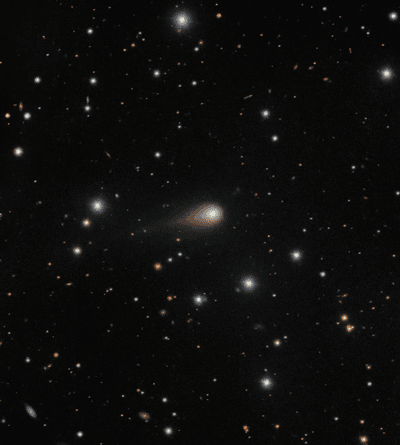


Comet 3I/ATLAS is now past the orbit of Jupiter, never to be seen again by the inner solar system. This doesn’t mean we are done learning about this fascinating object, the third known interstellar visitor. New observations have revealed the outgassing of methane in the months following its closest passage to the Sun. This is the first time that astronomers have measured methane emission from an interstellar object.
Using the mid-infrared instrument on JWST, researchers from Caltech have determined the emission of different molecules, including methane. The observations were conducted on December 15 and 16 and then again on December 27, just days before and after the closest passage of 3I/ATLAS to Earth. "Close" here is a relative term; it was 270 million kilometers (168 million miles).
The keen eye of JWST was still able to deliver many insights. The team measured the presence of water and carbon dioxide, as well as methane. This is all pretty standard for comets. Comets are made of a nucleus, a big block of ice and rock, so as a comet approaches the Sun, it begins to sublimate, releasing gases and creating a fuzzy atmosphere: the coma.

Comet 3I/ATLAS had its closest passage to the Sun on October 29, 2025, at a distance of approximately 203 million kilometers (126 million miles). The JWST observations came as the comet was already quietening. In the 12 days between the observations, the team measured a distinct reduction in water outgassing from the nucleus.
It still had a lot of water ice production, not from the nucleus but from the sublimation of ice in the coma. Different telescopes had also reported this particular feature, linking it to the release of larger particles and the formation of the peculiar anti-tail. Comets' tails point away from the Sun, as the solar wind pushes away particles. But anti-tail can occasionally form if the particles are not as easily pushed.
This does not remain the only peculiar thing from this object. Compared to the standard solar system comet, 3I/ATLAS contains more carbon dioxide than water, and more methane than water. The comet is believed to be much older than the Solar System and it has been traveling across interstellar space for a very long time.
"It's a very interesting object," lead author Matthew Belyakov, a graduate researcher at Caltech, said in a statement. "It has been traveling through the galaxy for at least a billion years. The high speed at which it flew past us gave just a narrow window to study it."
We are still waiting for more data analysis from some deep-space missions that were able to study the comet. 3I/ATLAS was very different from previous interstellar objects 1I/’Oumuamua, discovered in 2017, and Comet 2I/Borisov in 2019. It is faster, large, more active, and with a different composition. This brief passage was a unique opportunity, and astronomers worldwide have not missed it.
"JWST is going to look at 3I/ATLAS one more time this spring," Belyakov added. "It's already getting tough to observe; it's now out by Jupiter."
A paper describing the results is published in the journal The Astrophysical Journal Letters.