Space and Physics
 PUBLISHED
 3
3



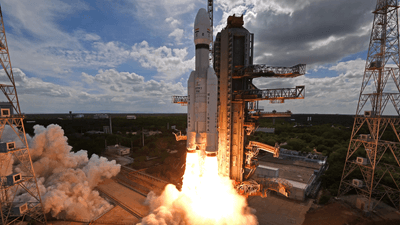


After a successful launch on Friday, July 14, India is on its way to achieving its goal of becoming the fourth nation ever to land on the Moon and explore its surface, setting down near the lunar South Pole towards the end of August.
This is the third mission to the Moon for the Indian Space Research Organisation (ISRO). Chandrayaan 3, which includes a lander and rover, is expected to land on the Moon between August 23 and 24. If the landing is successful it will be an incredible achievement. India will become the fourth country to successfully carry out a controlled landing on our natural satellite and the first mission to reach this unexplored but exciting region.
The lunar South Pole is a cold region temperature-wise, as the inside of many of its craters never see sunlight. Although you could argue that it's also so hot right now, as many missions are planning to go there, including returning humans to the Moon with Artemis III. Evidence has shown that water ice is found in those permanently shadowed regions inside craters, ice that could be used by future astronauts for long-term exploration missions.
The Chandrayaan 3 mission is set to demonstrate end-to-end capabilities to both soft-land and rover over the surface of the Moon. India’s first lunar mission was a resounding success, conducting important observations from orbit and even executing a successful impact of a probe on the surface (again on the South Pole). Chandrayaan 2 was unfortunately not as lucky, and the Vikram rover had problems with its software and speed on descent leading to a crash landing. Still, its orbiter is doing amazing science around the Moon, including snapping some of the highest-resolution images of the surface yet.
To avoid a repeat of the same fate, the ISRO team working on this mission has improved the soft-landing capabilities. This ranges from software controlling the retrorockets to having more flexibility when it comes to the landing area. For Chandrayaan 3, the possible area of touchdown is 40 times larger.
The lander and rover have an extensive suite of instruments to study the mineral composition of the surface of the Moon at the South Pole as well as to measure moonquakes. The mission is high stakes; navigating the southern polar region with a rover will not be easy. Availability of sunlight at those latitudes is limited, the terrain is difficult and temperatures can get very low, needing power to keep the instruments heated. The challenges however are worth the reward of being the first to explore a region that is expected to be pivotal to the future exploration of the Moon.
It's not just the lander and rover that will be doing science, though. The Propulsion system that will take the mission to just 100 kilometers (61 miles) from the surface of the Moon is equipped with instruments to actually study the Earth from lunar orbit.