Space and Physics
 PUBLISHED
 2
2


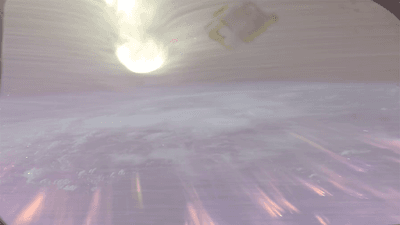


This time last year, NASA's Orion spacecraft successfully returned to Earth. To celebrate this anniversary, NASA showed off stunning footage of the ship falling through our atmosphere at 32 times the speed of sound
The ship, designed to take humans further than we have ever traveled before, was launched using NASA's Space Launch System (SLS) on November 16, 2022, the first time the massive rocket had been demonstrated.
Orion went on to fly for 25 days, six of which were in orbit around the Moon. It reached a distance of 434,500 kilometers (270,000 miles) away, traveling further than any spacecraft designed for humans so far, before plunging into our atmosphere at around 40,000 kilometers per hour (25,000 miles per hour).

There was another first as Orion returned to Earth: It became the first spaceship designed for humans to attempt a "skip" reentry, bouncing off the atmosphere like an incredibly expensive stone on a lake. The approach will help the craft land consistently at the same site, despite where it first enters the Earth's atmosphere.
“The skip entry will help Orion land closer to the coast of the United States, where recovery crews will be waiting to bring the spacecraft back to land,” Chris Madsen, Orion guidance, navigation, and control subsystem manager, explained in a statement ahead of the launch. “When we fly crew in Orion beginning with Artemis II, landing accuracy will really help make sure we can retrieve the crew quickly and reduces the number of resources we will need to have stationed in the Pacific Ocean to assist in recovery.”
Footage of the reentry was tweeted by NASA, though the longer view below shows the spaceship gliding down on parachutes before being recovered.
“With Orion safely returned to Earth we can begin to see our next mission on the horizon which will fly crew to the Moon for the first time as a part of the next era of exploration,” said Jim Free, NASA associate administrator for the Exploration Systems Development Mission Directorate, in a statement. “This begins our path to a regular cadence of missions and a sustained human presence at the Moon for scientific discovery and to prepare for human missions to Mars.”
With all fingers tightly crossed, this could soon be a view enjoyed by astronauts returning from a Moon mission. Though don't get your hopes up for that happening anytime in 2024.