Humans
 PUBLISHED
 2
2



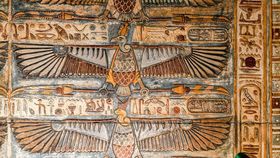


Two millennia's worth of soot and dirt covered the ceiling frescoes in the temple of Khnum in the Egyptian city of Esna, protecting the colors underneath. Now, painstaking restoration work from archeologists has brought these incredible pieces of art back to life.
The frescoes have 46 images of vultures, representing, in turn, the Upper-Egyptian vulture goddess Nekhbet and the Lower-Egyptian serpent goddess Wadjet, who is also depicted as a vulture with open wings, although keeping the head of a cobra and the crown of Lower Egypt. Nekhbet is wearing the Upper Egypt crown.

The restoration was conducted by the Institute for Ancient Near Eastern Studies at the University of Tübingen and the Egyptian Ministry of Tourism and Antiquities. They have been working since 2018 to bring the colors of the frescoes back into view.
“Temples and ancient depictions of the gods were often painted in brilliant colors, but these have usually faded or even disappeared totally as a result of external influences,” Professor Christian Leitz from the University of Tübingen, said in a statement.

The temple was dedicated to one of the earliest Egyptian deities, Khnum the ram-headed god who was seen as the god of the source of the Nile. At Esna, Khnum and his consort Neith are treated as the creator deities.
Construction of the religious building had begun during Ptolemaic time but most of the remaining parts are from the Roman era, probably around the time of Emperor Claudius (41-54 CE). The temple began to attract the interest of archeologists in Napoleonic times, but it was in the latter part of the last century that a more detailed study of it began in earnest.
“From the 1950s, the French Egyptologist Serge Sauneron systematically documented the Temple of Khnum at Esna and the paintings that were visible at that time,” said Tübingen scientist Dr. Daniel von Recklinghausen, “The temple’s complete range of images is unique in its wealth of figures and the state of preservation of the colors.”

“For the first time we can see all the decorative elements in relation to one another,” said Leitz. “This was impossible simply with Sauneron’s publication.”
The whole restoration was funded by the American Research Center in Egypt, the Ancient Egypt Foundation, and the Gerda Henkel Foundation. The team is now planning to translate all of the Esna inscriptions, as well as study the connection between all the images and writing in the temple. This upcoming work has been funded by the German research foundation.