Humans
 PUBLISHED





In the Siberian High Arctic lies a freezing island where humans somehow managed to eke out a brutal existence some 8,000 years ago. However, while the site represents possibly the most remote prehistoric human settlement on Earth, new research shows the residents of this ancient outpost weren’t entirely cut off from the rest of the world and were surprisingly well connected to long-distance exchange networks.
Located on Zhokhov Island in the New Siberian Islands, the site of Zhokhov was inhabited at a time when sea levels were lower than they are now and the islands were still connected to the Eurasian mainland. Despite its extreme northerly latitude, the settlement has yielded a surprising number of artifacts, including stone tools and several hundred objects made of mammoth ivory.
Based on these discoveries, researchers believe that Zhokhov was inhabited year-round between 8,250 and 7,800 years ago. To survive in this harsh climate, prehistoric hunter-gatherers preyed on the reindeer herds that roamed the Arctic tundra between spring and autumn.
In winter, however, local residents had to resort to hunting polar bears because less dangerous prey animals were harder to come by. It’s thought that Zhokhov’s population mostly targeted female polar bears by extracting them from their dens, where they typically spend the winter nursing their newborn cubs.
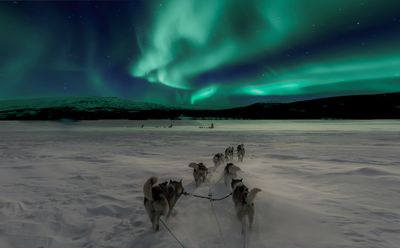
Another major survival strategy involved the breeding of large dogs, which enabled transport by pulling sleds. Notably, the world’s oldest known wooden dog sleds have been found at Zhokhov, and the authors of a new study suggest that canine-powered transportation may have enabled these hunter-gatherers to maintain vital connections with other human populations.
Analyzing the geochemical signatures of 14 of the 79 obsidian tools discovered at Zhokhov, the researchers found that this material was sourced from the area around Lake Krasnoe, some 1,500 kilometers (930 miles away). They therefore suspect that obsidian was brought to Zhokhov via an extensive network of interconnected trading routes, which relied on dogs to help move materials and people across the vast frozen landscape.
“We suggest that the Early Holocene people of the north-eastern Siberian Arctic maintained a well-developed network, which facilitated the exchange and transmission of information and knowledge, and covered a vast region of up to four million square kilometers [1.54 million square miles],” write the study authors. Not only did this enable the movement of goods like obsidian in and out of Zhokhov, it would also have allowed for the site’s inhabitants to communicate with people living thousands of kilometers away.
“Surprisingly, the capacity of prehistoric people to cover large distances and communicate with each other was almost as effective as historical communication systems known in other similar parts of the world,” write the authors.
According to the researchers, the maintenance of these links depended on “well-developed sledge technology," underscoring the importance of the world’s earliest transport dogs to ancient hunter-gatherers in the High Arctic.
The study has been published in the journal Antiquity.