Humans
 PUBLISHED
 1
1




Being able to know the time at any given moment is a bit of a modern luxury/annoyance, depending on how often your kids ask you what time it is. It wasn't too long ago that humans would pay to see the correct time, and it wasn't too long before that, given the length of time humanity has been around, that we were working out roughly what time it was by the shadows a gnomon left on a sundial.
Mechanical clocks, atomic clocks, and shadows are not the only ways that humans have attempted to keep track of the hours and minutes. In fact, we've come up with a variety of novel ways of doing so, largely due to the fact that sundials don't work too well (as you might expect) in the middle of the night, or when it's a little too cloudy.
In Ancient Egypt, water clocks were used from at least 1350 BCE. These measure the time by allowing water to flow out of a vessel at a known rate, whilst markings within the vessel let you know what the time is.
Sounds simple, but ancient people had to figure out ways to account for slower flow later on due to dropping water pressure, making it a neat bit of timekeeping. Nevertheless, these outflow water clocks were largely used for measuring shorter periods of time, more like an egg timer than an actual clock.
More complicated water clocks became available over time, including Ctesibius’s Water Clock, which was reasonably accurate, and used for a variety of purposes.
"During the first Alexandrian period, it [Ctesibius's clock] was adapted as a way for physicians to count the pulse," Lisa Nocks explains in The Robot: The Life Story of a Technology. "It was also used in law courts to time speeches. A long tube was plunged into the water and when it was full, the opening at the top was closed. When it was reopened, the water dripped through a small opening at the lower end. A person was free to speak until the tube was empty."
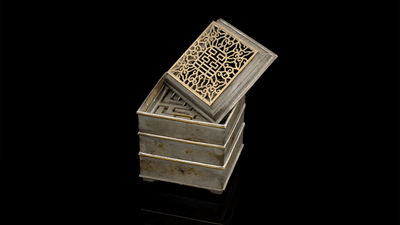
While these were good clocks, you had to use your eyes to see the time, which as we all know is a big hassle. In Medieval China and Japan, inventors came up with a clock that addresses this nonsense, in the form of a "fragrance" or "incense" clock. These were developed within China before water clocks, emerging some time before 520 CE.
The most simple of burning clocks, not to diminish the thinking behind them, were candles that burned at a known rate, with markings down the side to indicate how many hours have passed since it was lit. This form was the most widely distributed burning clock, but not the most sophisticated.
"[Additionally], there was the 'incense seal' consisting of a continuous trail of powdered incense marked off into equal periods to enable the observer to measure the passage of time by the progress of the burning incense with relative accuracy," Silvio A. Bedini explained in a 1963 paper.
But these clocks still required looking at things, which we have agreed above is intolerable. In huge progress, clocks were developed that burned until they reached certain markers along their path, which then emitted their own smells. Looking at which chimney the smoke came out of, in certain versions of the clock, would also reveal how much time had passed since you lit up.
"It is entirely possible that the pegs or tablets marked with the zodiacal characters inserted along the incense trail to denote time intervals could in actuality be tablets of hard-paste incense, each made from a different recipe," Bedini added.
"When the progressive burning of the path reached one of the markers, the marker too would be consumed and the resulting variance in aroma would be detected by the priest in attendance, so that he could tell the particular hour which had elapsed from the scent."
In short, you would be able to smell the time. Some of these had an additional system of balls that would drop when the incense burned through, allowing you to hear the time change as the balls clattered into a tray below.
Unfortunately, these kinds of clocks are no longer in use except as a novelty, with the modern-day equivalent being identifying lunchtime when your colleague starts microwaving fish.