Culture and Society
 PUBLISHED
 7
7


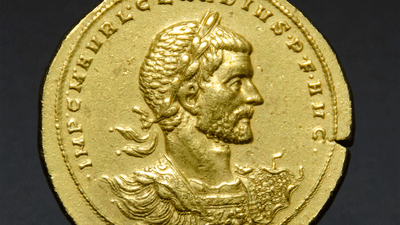


In September 1985, two brothers and a friend looking for sea urchins in southern Corsica, France, discovered a massive hoard of Roman treasure buried on the sea floor.
Félix Biancamaria, Ange Biancamaria, and their friend Marc were diving in the Gulf of Lava when Félix first spotted something shining on a rock below. The three soon found that the shiny metal thing was a coin; there was plenty more to be found down there, and they had been down there for some time.
"They were full of concretions," Félix told French news outlet Midi Libre. "We soaked them in acid, and they came out in perfect condition. We knew nothing about this kind of thing. And we didn't even have an idea where to find a numismatist."
The brothers had the coins appraised by an expert from Nice, who informed them that they were rare Roman coins. The collection, which soon became a little more dispersed than is archaeologically ideal, was thought to total up to 1,400 individual coins minted during the reigns of Gallienus (253-268 CE), Claudius II (268-270 CE), Quintillus (270 CE), and Aurelianus (270-275 CE).
Unfortunately for archaeology, and eventually for the divers who found the treasure, they were pretty valuable and rare. They were paid 50,000 francs for the initial coins, and knew exactly where they could find more.
The trio was planning on returning to find more coins, but had to wait until the water was calm enough to go diving for treasure once more. When they did return, they said that they found nearly 600 more coins. Again, they sold them off, and at eye-watering prices. Some single coins could sell for around €250,000.
"I lived like a millionaire. I spent lavishly, buying cars and watches. I helped friends. I always told myself that you have to enjoy life and that money only has value if you spend it," Félix said. "I don't regret anything. If I had to do it all over again, I would do even worse."
Eventually, the Gulf of Lava ran out of coins. It is thought that it had gotten there during a shipwreck, and by looking at the final coins issued – during the reign of Aurelianus – archaeologists can date that shipwreck to around 272-273 CE.
"The second series [of coins issued during the reign of Aurelianus] marks the chronological end of the treasure, and its 177 aurei were issued with just 3 obverse-dies and 3 reverse-dies (one pair of die having struck up to 82 specimens)," Sylviane Estiot, director of research at the French National Centre for Scientific Research, explains.
"This final group, which left the mint’s officinae without being split up, went directly into the possession of the high-ranking owner of the treasure. This allows us to date the shipwreck very closely to the issuing of this series, at the end of 272 or the beginning of 273."
We will likely never know what happened to the ship, which has never been found.
"It is an extraordinarily substantial treasure which must therefore have belonged to someone extremely important," Michel L'Hour, former head of the Department of Underwater and Submarine Archaeological Research at the Ministry of Culture (Drassm) told Ouest-France. "Is it a ship that sank offshore and someone hid the treasure, or was it someone who stole it? All hypotheses are possible."
With the collection largely sold – it is also believed that parts of the treasure were sold prior to 1985, since 1958 – we will likely never know its exact contents, either. The finders say that they melted down a few of the coins in worse condition, and a gold plate worth around €6-8 million was amongst the finds that Félix outlined in a book.
Taking the treasure and selling it off, as well as being bad archaeological practice, didn't go well for the brothers. In 1994, Félix, his brother, and their friend were convicted of having sold the coins, with treasure and antiques found at the bottom of the sea belonging to the state. They were fined and given 18-month suspended sentences.
In January 2024, Félix was back on trial again, after being accused of trying to sell the golden plate to one Jean-Michel Richaud. During this case, the defense argued that the law at the time only applied to treasure found from shipwrecks, and the shipwreck had never been found.
"Treasures and antiques discovered at the bottom of the sea of our territory belong to the state," France’s Central Office for Combating Trafficking Deputy Jean-Luc Boyer said, per Numismatic News. "However, if it was found on land, the law is a little different; part could belong to the finder, but they are obliged to make a discovery declaration to the state via the culture ministry."
Other ideas about how the treasure got there include that a ship was burned, or that the treasure was hidden in Corsica but deposited on the sea floor after a landslide. But in the end, the court was unconvinced by this argument. Biancamaria, then 67, and Richaud, 68, were both found guilty of "receiving stolen goods" and "possession without proper documentation of maritime cultural property", and were given suspended sentences and a joint €200,000 fine.