


 Health and Medicine
 PUBLISHED




In recent weeks, Robert F. Kennedy Jr., United States Secretary of Health and Human Services, has been criticized for a controversial vaccine study proposal, likened to the infamous Tuskegee Experiment that took place in the US between 1932 and 1972.
The vaccine skeptic Secretary of Health put $1.6 million towards the study, which would see 14,000 newborn infants in Guinea-Bissau, West Africa, become test subjects for research into Hepatitis B vaccination. This means half of the infants, in a country with high levels of the viral liver infection, would be given the vaccine at birth, and half would receive it six weeks later.
"Activities will include conducting a randomized controlled trial to assess the effects of neonatal Hepatitis B vaccination on early-life mortality, morbidity, and long-term developmental outcomes," a document from the Department of Health and Human Services explains.
Vaccination for Hepatitis B at birth has been recommended by the UN since 2009, with the US implementing this policy as far back as 1991, vastly reducing cases within the country. Guinea-Bissau has recently decided to implement vaccines at birth to all infants, beginning in 2027. But if this experiment goes ahead, 7,000 newborns will be subject to the delayed vaccine, and all the health risks that involves.
"These children have a 90 percent chance of developing cirrhosis (chronic liver disease) or liver cancer later in life," Paul Offit, an American pediatrician specializing in infectious diseases, vaccines, immunology, and virology, explains of children receiving the dose at six weeks, on Substack.
"RFK Jr., the Secretary of Health and Human Services, will soon conduct his own Tuskegee experiment," Offit added in the piece.
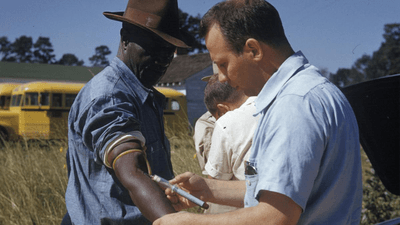
So, what was the Tuskegee experiment, exactly? In 1932, the US Public Health Service and the Tuskegee Institute began an unethical experiment on 600 Black men without their informed consent. Over the next 40 years, it would lead to significant loss of life and unnecessary suffering for the participants, before it was exposed in 1972.
The study – titled Tuskegee Study of Untreated Syphilis in the Negro Male – began with 399 men with syphilis and 201 without. The goal was to “observe the natural history of untreated syphilis” in African Americans, essentially by tracking the men over the course of many years, ensuring they didn't receive treatment for their disease.
There are very few who would volunteer for such an experiment, which the researchers involved were clearly aware of. As such, they informed the volunteers from Macon County, Alabama, that they were being treated for "bad blood", and that the treatment would be paid for by the US government.
“Free Blood Test; Free Treatment, By County Health Department and Government Doctors,” signs advertising participation in the study read. “YOU MAY FEEL WELL AND STILL HAVE BAD BLOOD. COME AND BRING ALL YOUR FAMILY.”
What they actually needed treating for was syphilis, for which they hadn't even been informed of their diagnosis. Instead, they were given placebos by local doctors who were in on the experiment, and treatment that was known to be ineffective. As an extra incentive, they were offered free meals and, rather grimly, free burial insurance.
Already unethical in its own right, the experiment took a turn for the worse in 1947, when penicillin was proven to be a highly effective treatment for syphilis. The study continued on regardless, and the men remained untreated.
Over the years, the men began to experience the tertiary phase of syphilis, and the scientists watched as they slowly began to go blind, suffer from organ failure, develop dementia and paralysis, and eventually die. In order to conduct autopsies on their subjects, the scientists began paying funeral expenses.
Despite opportunities to stop the experiment and treat the men for their condition, no such move was made. In 1965, the researchers argued that it was now too late to offer penicillin to the men involved in the study, as the disease would have progressed too far for treatment to be effective. In 1969, the US Centers for Disease Control and Prevention (CDC), which had taken over from the US Public Health Service in conducting the study, again opted to continue with the experiment.
The study went on until 1972, when a whistleblower leaked information to the Washington Star. When the story came out, people were outraged, and the experiment was ended shortly afterward. Some participants had been added in the previous years, according to a follow-up report in the New York Times, though precisely how many was unknown.
Years later, in 1997, President Bill Clinton offered this apology on behalf of the United States to participants in the study: "To the survivors, to the wives and family members, the children and the grandchildren, I say what you know: No power on Earth can give you back the lives lost, the pain suffered, the years of internal torment and anguish."
"What was done cannot be undone. But we can end the silence. We can stop turning our heads away. We can look at you in the eye and finally say on behalf of the American people, what the United States government did was shameful, and I am sorry."
But for the participants in the study, the damage was done. By the time the experiment was ended in 1972, 128 patients had died of syphilis, 40 of the men's wives had been infected with the disease, and 19 of their children had had congenital syphilis passed on to them.
The new vaccine experiment has clear parallels. If the study goes ahead, and at the moment it isn't clear whether it will, a disease that has a known vaccine would be allowed to develop in thousands of newborn children, at detriment to their health.
"In many countries, where 8%–15% of children used to become chronically infected with the hepatitis B virus, vaccination has reduced the rate of chronic infection to less than 1% among immunized children," the World Health Organization explains.
The study would place these babies at risk of this disease unnecessarily, ahead of the immunization at birth scheme to be rolled out in 2027.
"RFK Jr. sees this one-year delay in implementation of the much-needed hepatitis B birth dose as a 'window of opportunity' to test his theory that the vaccine causes long-term neurological problems," Offit adds, "even though more than 30 years of experience in the United States has disproved his claims."


 9
9