Humans
 PUBLISHED


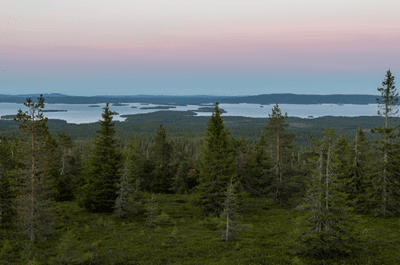


A huge prehistoric cemetery discovered in Lapland, just south of the Arctic Circle, is challenging what we know about how far Stone Age societies trekked into the bitterly cold, far-flung stretches of Northern Europe.
As per a new study on the prehistoric graveyard, this 6,500-year-old site might be one of the largest Stone Age cemeteries in northern Europe.
Known as Tainiaro, the site is located in the sprawling boreal forest of northern Finland near Bothnian Bay in southwestern Lapland, around 80 kilometers (50 miles) south of the Arctic Circle.
It was discovered by chance in 1959 thanks to a group of local workers extracting sand. After unearthing several stone artifacts, the workers reported the findings to local authorities – but their discovery didn’t receive the attention it deserved.
Around 30 years ago, a team of archeologists led by Tuija Laurén attempted to excavate the site, but their funds dried up and the research was left unpublished. Now, Laurén and a team from the University of Oulu have returned to the cemetery and compiled the first detailed picture of the site.

To their surprise, the Tainiaro cemetery was found to hold way more bodies than previously realized. Initial estimates suggested that 120 people were buried here, but their research indicates that the figure is closer to 200.
This scale is pretty unusual considering how far north (not to mention how cold) this part of the world is.
"The research on Tainiaro shows that apparently large cemeteries also existed near the Arctic Circle," Aki Hakonen, lead study author from the Department of Archaeology at the University of Oulu, said in a statement sent to IFLScience.
"The research raises questions about why such a site exists so high up on the map and whether there are similar cemeteries yet to be discovered in the dozen-or-so river valleys of the Bothnian Bay,” continued Hakonen.
The researchers describe the evidence as “quite elusive.” Unfortunately, the physical remains of the bodies – even bones – have been completely broken down due to the highly acidic soil over the millennia. As such, the main evidence is dozens of elongated pits.
The team compared the shape of the uniformly shaped pits to over 800 other Stone Age graves from 14 cemeteries in Northern Europe, affirming their argument that they were used to bury people.

Significantly, the pits often contained traces of charred remains and red ochre pigments. The researchers aren’t totally certain about the significance of this, but they believe it might have had some deep cultural significance to the unknown culture that buried their dead in this unsympathetic region of the planet.
“An ancient association between red ochre and fire, and with the warmth of the lifegiving hearth is just one possibility out of many, but one which resonates deeply, especially in the subarctic context,” the study authors write.
To pry deeper into this mystery, the researchers have started mapping Tainiaro with geophysical radar imaging, which will be able to uncover more insights without physically disturbing the site. They’re also hoping further research and excavations will reveal new information to illuminate the mysterious culture behind this cemetery.
“New soil samples could be analyzed for fossilized hair, which has been found in Stone Age graves in recent years. It seems animal furs and bird feathers were often used in burial rituals. Chemical analyses, such as the collection of ancient DNA directly from the soil, may provide unequivocal evidence for the burial interpretation or reveal entirely new findings that will guide our understanding of the Stoen Age society to an even more fascinating direction,” Hakonen remarked.
The study is published in the journal Antiquity.