Space and Physics
 PUBLISHED


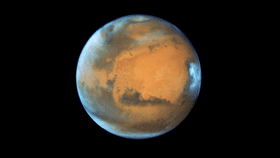


NASA has released a celebratory portrait of Mars in anticipation of its close approach to us later this month.
The Hubble Space Telescope snapped this particularly cool image of the Martian marble just last week, on May 12. Mars has been one of the favorite subjects of Hubble since it launched in 1990, but this image was captured at a particularly interesting time, when it was a mere 80 million kilometers (50 million miles) away from Earth.
Mars is going to make its closest approach to Earth in over a decade on May 30, when it will be 75.3 million kilometers (46.8 million miles) from Earth. Pretty amazing stuff, considering it can be as distant as 401 million kilometers (249 million miles) away. Unfortunately though, it won’t make the Red Planet much more visible to the naked eye.
As you can see (below), the image details Mars' clouds (seen in blue around its edges), its multiple craters and basins, along with its iconic rusty landscape. The imaging techniques, which pick up on multiple wavelengths of light, reveal details as small as 32 kilometers (20 miles) across.
Check out an annotated version of the image below and click here to read more about Mars' ensuing closest approach.

NASA, ESA, the Hubble Heritage Team (STScI/AURA), J. Bell (ASU), and M. Wolff (Space Science Institute)