Space and Physics
 PUBLISHED
 1
1



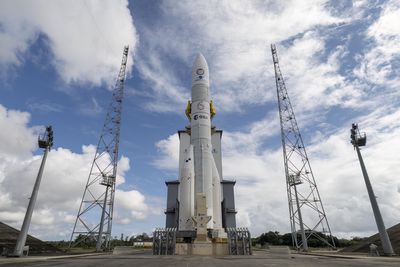


The European Space Agency (ESA) is going to launch its brand-new rocket Ariane 6 next week. The window for the inaugural launch opens at 2pm ET (6pm GMT) on July 9 and will last for three hours. There is trepidation across ESA and the European space industry – this has been a long time coming.
The rocket is the successor of Ariane 5, which worked from 1996 until 2023. It will be lighter, taller, and more affordable than its predecessor. The hope is that it might also improve the level of success. Ariane 5 is among the most successful launches, accumulating a single partial failure between 2003 and when it was retired last year.
“Ariane 5 was really the workhorse of Europe to bring heavy and medium-sized satellites into space. Ariane 6 will be more modern, will be cheaper, and more versatile. That means it has more flexibility to leave satellites in different orbits,” Dr Josef Aschbacher, ESA Director General, told IFLScience.
“We use the infrastructure that satellites provide every single day: navigation, telecommunication, Earth observation… but we also explore the universe with the satellites that we launch into space with our Ariane rockets.”
Ariane 6 will launch from the ESA’s Guiana Space Centre near Kourou in French Guiana. Being so close to the equator (just 5° North) means it can get to space more easily, or with more payload. That’s why rockets tend to launch in tropical regions.
The rocket comes in two versions called 62 and 64, depending on the number of boosters used. Choosing one or the other depends on which orbit and what kind of weight the payload is like. The biggest configuration can deliver a "heavy lift" to the Moon and deeper space. Talking about the orbit, the versatility of this rocket lies in the fact that it has a reignitable upper stage, so it can launch multiple satellites on specific orbits in a single flight.
The livestream will begin about 30 minutes before launch. Ariane 6 is designed with sustainability in mind. its launchpad is designed to limit its carbon footprint and to reuse the water in the deluge system over and over again. The rocket parts are delivered to French Guiana via a partially wind-powered cargo ship, and the hydrogen fuel is produced using solar power and water, reducing carbon emissions by 80 percent. The full environmental impact analysis will be completed only once the rocket actually flies next week.
IFLScience will be at the Guiana Space Centre to see the launch and answer your questions. We will be live on Facebook and on Instagram – where ESA will do a takeover for the day – from about 15 minutes from the launch.
If you have questions about this important rocket or any burning queries about rocket science you want answered during the livestream, please email me at acarpineti@iflscience.com.