Health and Medicine
 PUBLISHED


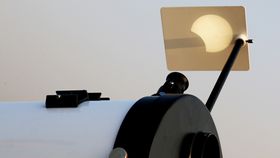


You might not have heard, but there’s going to be a total eclipse on Monday, August 21.
Of course, we’re kidding. For the last few weeks, you’ll have been met with a slew of advice on where to view the eclipse, when to view it, and how to view it safely so you don’t sear your eyeballs and go blind. And now we’re here to tell you that if you didn’t manage to get your mitts on some snazzy solar eclipse glasses you can still view it safely by using some basic household items.
NASA’s Jet Propulsion Laboratory has a helpful guide to making a pinhole camera to view an eclipse, which doesn’t involve looking directly at the Sun during the partial eclipse, but projecting the image onto a surface you can look at safely.
All you need is some white card, aluminum foil, scissors, tape, and a needle. Cut a hole in the center of the white card (or stiff paper), place the foil over the hole and stick it down with the tape. Then, using the needle, pierce the center of the hole.

Then, place another piece of white card on the ground, and with your back to the Sun, hold the piece with a hole in it over the card. An image will appear projected onto the card on the ground. The farther you hold your “camera”, the bigger the projected image.
To get an even better image you can try holding binoculars up to the Sun (don’t look through them), and aiming the eyepiece at the white card.
Or an even better image involves slightly more effort, a telescope, and a saw, but is worth it. NASA, The Astronomical Society, and Nightwise created this handy guide to building a “Sun funnel”, which allows multiple people to enjoy viewing the image at once.
Viewing the eclipse will be a wonderful experience and a memory to treasure. Watch it safely, so you don't end up with this date burned into your memory for the wrong reasons.