Space and Physics
 PUBLISHED

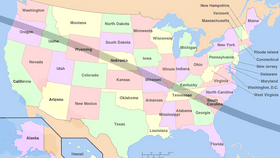


Make sure you have August 21 earmarked in your calendars and your solar eclipse glasses at the ready – if you’re in the US, that is. For the first time since 1918, a solar eclipse will pass through the entire United States from the west to east coast.
If you’re lucky enough to be located along one particular 70-mile-wide stretch of land (as shown in the image above), you'll get to see a total solar eclipse. This happens when the Moon is directly between Earth and the Sun, blocking out all of the Sun’s light.
Everyone else will see a partial solar eclipse. Though the exact appearance of it will depend on where you are. If you can’t wait until Monday to find out how it will look, you can check out a simulation created by a team from NASA’s Jet Propulsion Laboratory.
Just select a location on the 3D Earth graphic and the simulation will show you what the eclipse will look like as it passes through the US.
Here are some projections for 10 of the most populated US cities.
New York, NY, at 2.34pm EST

Los Angeles, CA, at 10.33am PST

Chicago, IL, at 1.19pm CST

Houston, TX, at 1.21pm CST

Philadelphia, PA, at 2.41pm EST

Phoenix, AZ, at 11.41am MST

Jacksonville, FL, at 2.48pm EST

Indianapolis, IN, at 2.26pm EST

Columbus, OH, at 2.33pm EST

Charlotte, NC, at 2.41pm EST

Just remember – looking directly at the Sun can cause permanent eye damage. So if you do decide to take part, remember to bring a pair of solar glasses and read up on how to watch the solar eclipse safely.
[H/T: Business Insider]