Nature
 PUBLISHED
 1
1


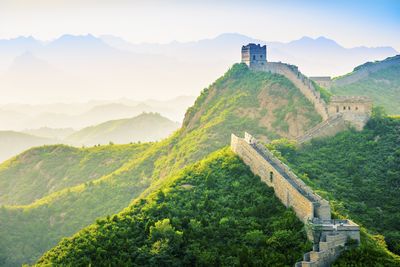


The Great Wall of China might’ve been able to hold off ancient enemies, but time and weather eventually come for even the sturdiest of constructions. With up to 30 percent of the Ming-era wall disappearing over the last 500 years, some have put this down to the cyanobacteria, lichen, and moss residing within the wall. New research, however, has suggested that these “biocrusts” are actually helping to keep the Great Wall together.
When the Ming region of the wall was constructed between 1368 and 1644, with its characteristic tall brick walls and fortifications, workers often used rammed earth – soil, gravel, and other natural materials – as a building material. In some places, this has fostered a “living” part of the wall, allowing for the growth of cyanobacteria, mosses, and lichens that researchers believe lend stability to the wall as a biocrust.
To reach this conclusion, researchers began by taking samples from eight sections of the Ming-era portion of the wall and found that 67 percent contained biocrusts. They then compared the mechanical strength and soil stability of the biocrust samples versus those that were only plain rammed earth.
.jpg "Researcher Yousong Cao sampling at the Great Wall")
The results revealed that the biocrusts lent an impressive stability to the wall. As the team wrote in their paper: “Compared with bare rammed earth, the biocrust-covered sections exhibited reduced porosity, water-holding capacity, erodibility, and salinity by 2 to 48%, while increasing compressive strength, penetration resistance, shear strength, and aggregate stability by 37 to 321%.”
This did, however, depend on the composition of the biocrust and the climate in the region where the samples were taken. In arid regions, for example, cyanobacteria were the dominant party in biocrusts, whereas mosses tended to thrive the most in wetter, semi-arid environments. The researchers found it was the moss-dominated crusts that most significantly enhanced the wall’s strength and stability, reducing its erodibility.
.jpg "Close-up view of biocrusts on the Great Wall of China")
It's thought that biocrusts do this by secreting substances that bind with the rammed earth, forming a structure akin to cement. The hardened product of this process helps to buffer the effects of the climate, such as wind, rain, and temperature changes.
“Biocrusts serve as stabilizers, consolidators, sacrificial layers, and drainage roofs, combining the protective functions of several conventional measures into one eco-friendly approach,” the authors conclude.
While biocrusts might protect the Great Wall from the weather, there’s little they can do when it comes to stopping humans. Back in September, construction workers looking for a shortcut damaged a portion of the wall in Shanxi province beyond repair.
The study is published in Science Advances.