Space and Physics
 PUBLISHED


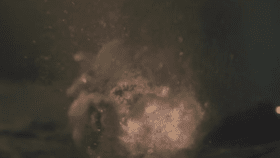


This GIF shows the weird and wonderful Leidenfrost effect. If a liquid comes into contact with a very hot surface, hotter than its boiling point, a gas layer forms between the liquid and the surface which, for a short time, separates and partially insulates the liquid. You may have noticed this in your kitchen if you've ever sprayed water onto a hot pan, resulting in beads of liquid water seemingly darting around the pan's surface.
Image credit: TheBackYardScientist
In the GIF we see this physical phenomenon in action. The copper ball was heated up until it was red hot. We see the ball when it first hits the water and it becomes protected by a layer of vapor created from this Leidenfrost effect. However, as the ball begins to reduce in temperature by the cooling water, the water makes contact with the ball, instantly boiling and ripping off a layer of copper oxide.
Check out the full video, below, by TheBackyardScientist which shows an experiment detailing even more about Leidenfrost effect and lots of hot metal balls.