Humans
 PUBLISHED
 1
1


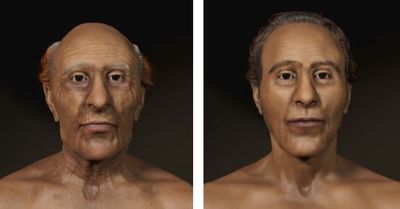


One of the most iconic Pharaohs ever to rule Ancient Egypt has been resurrected in digital form, as both a middle-aged powerhouse and an ailing elderly king. Using Computed Tomography (CT) scans of his mummy, researchers have reconstructed the face of Ramesses II as it would have appeared at the age of 45, when he was in his pomp, and at the time of his death at 90 years old.
Often referred to Ramesses the Great, Ramesses II ruled the New Kingdom of Egypt from 1279 to 1213 BCE. During his legendary 66-year reign, the Pharaoh cemented his status as one of the most powerful kings in Egypt’s history, taking on numerous regional foes and expanding the empire.
According to the team behind the new 3D facial depictions, Ramesses II “was at the peak of his military activities” around the age of 45, before eventually perishing at 90 years of age. Describing their attempts to recreate the great king’s likeness, they explain that “the mummified body of Ramesses II was scanned using a modified CT protocol suitable for ancient, desiccated bodies.”
Noting the incredible job that the ancient embalmers had done of preserving the Pharaoh’s mortal husk, the researchers say “the mummified body of Ramesses II is like a time capsule that preserved his facial features and hair, that allows us to study his finer facial characteristics in depth.”
For instance, the elderly Ramesses clearly had a bald head, with hair remaining only on the back and sides of the royal dome. These enduring follicles had been dyed orange with henna, much of which was still present on the mummified body after more than 3,200 years.
The king also had pierced ears, although archaeological evidence suggests that males in Ancient Egypt generally sported earrings only as young boys, which is why the researchers chose to depict the adult Ramesses without any jewelry. It’s also clear from the mummy that Ramesses II had a “honey-brown skin tone” and a “very prominent nose”, which the embalmers had attempted to preserve by stuffing it with items such as seeds, resin, and an animal bone.

To recreate the middle-aged Ramesses, the researchers used a series of computer modeling tools to remove certain signs of old age, such as a droopy nose, thin lips, and hollow cheeks due to the loss of teeth. “The younger Ramesses II face model was therefore depicted with a stronger, firmer jawline, shorter nose and ears, fuller cheeks and lips, fewer wrinkles, mild facial folds and creases, and darker, fuller hair,” explain the researchers.
The study is published in the Journal of Archaeological Science.