Health and Medicine
 PUBLISHED
 37
37


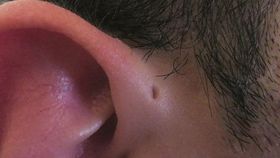


You might have noticed that a few people have a barely noticeable hole where the top of their ear cartilage meets their face. Believe it or not, it’s probably not the remnants of an old piercing they had when they were 15.
Just 0.1 percent of the population have it in the US, 0.9 percent in the UK, and as many as 4 to 10 percent in Asia and parts of Africa, according to one study. In South Korea, that figure could be as high as 5 percent, and it’s most common in people of African or Asian descent.
It’s actually a congenital disorder called preauricular sinus. Although harmless in itself, it can be susceptible to infection. It is caused by the first and second pharyngeal arches. This is a structure found in all vertebrates that occurs during embryonic development. In mammals, they go on to form the structures of the head and neck, but in fish they also help develop into their gills.
It’s this odd connection that led Neil Shubin, an evolutionary biologist, to speculate that the holes could be an "evolutionary remnant of fish gills," according to Business Insider. Of course, that’s currently a theory that hasn't been scientifically tested. But nevertheless, when you think that we still have tailbones, goosebumps, and appendixes from our evolutionary forebearers, it's certainly not impossible.