Health and Medicine
 PUBLISHED

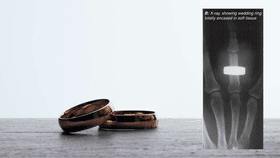


This is what can happen if you don't take off your wedding ring:

Of course, there is more to the story than an extreme fondness for jewelry. The extreme swelling, or myxoedema, was likely the result of hypothyroidism – a condition that can also cause weight gain, fatigue, and increased sensitivity to the cold among other things. Symptoms develop when the thyroid is on slo-mo, yielding far fewer hormones than the body requires.
The case study is from 2003 but was recently brought to attention by Reddit user BinaryPeach, who uploaded the picture and posted the medical explanation to the platform on Friday.
According to the original article, published in The Medical Journal of Australia, the patient was a 44-year-old woman with “a scant history of schizophrenia” and an intellectual disability. Andrei Catanchin and Peter R Ebeling, the article's authors, explain that closer examination "revealed classic clinical features of profound hypothyroidism," as well as a lump on the patient's right finger.
Later, investigations confirmed their suspicions and provided evidence for a hypothyroidism diagnosis in addition to anemia and a low-grade staph infection. Both the hypothyroidism and the infection could explain the swelling. As the Oxford Dictionary puts it: myxoedema is the “swelling of the skin and underlying tissues giving a waxy consistency, typical of patients with underactive thyroid glands.”
The wedding ring – which, by this point, was fully encased in soft tissue – had to be removed surgically. A histopathological examination showed there was a foreign body granuloma (that is, an inflammation caused by an immuno-response to a foreign object – in this case, a wedding ring) with chronic low-grade staph infection.
A staph infection is caused by the bacteria Staphylococcus aureus, found (not-uncommonly) on the skin or in the nose. Usually, they do not cause much of a problem and might lead to a minor skin infection at most. However, they can cause bigger (sometimes even life-threatening) health problems.
Because the way a staph infection presents can be so wide-ranging, there is no definitive list of symptoms but it can cause cellulitis. Cellulitis – which is not described in the case study but does share characteristics with the images pictured – is an infection affecting the deeper skin layers. It can cause skin redness, swelling on the skin surface, and, on occasion, sores.
To treat the condition, Catanchin and Ebeling say the patient was put on thyroxine – the main hormone secreted by the thyroid. She was also given antipsychotic medication and transferred to a psychiatric institution. The case study reveals there was a marginal improvement in her mental state.