Health and Medicine
 PUBLISHED
 6
6


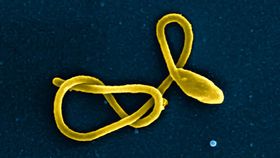


Just in time for the 2020 Tokyo Olympics, a Japanese lab has imported the Ebola virus, along with four other nasty hemorrhage-inducing viruses.
The fiendishly contagious pathogens were imported late last month from an unknown foreign country by the National Institute of Infectious Diseases (NIID), part of Japan's Ministry of Health, Labor, and Welfare, at their high-security laboratory in Musashimuraya, western Tokyo.
Inviting highly contagious germs onto an island might not sound like the smartest idea, but the import is all part of their masterplan to deal with a potential outbreak. With cases of Ebola being recently reported in the Congo, Japan is rightly wary of the risks involved in welcoming over 600,000 international tourists to their country next year for the Tokyo Olympics.
Japanese newspaper Ashai Shimbun reported in November 2018 that health authorities in Japan wanted to obtain the viruses to develop a better inspection system for infectious diseases before the games begin. They also argue having immediate access to the viruses is extremely important to make a quick and accurate diagnosis of a patient in the unlikely event of an outbreak.
Ebola is a viral hemorrhagic fever that affects humans and other primates that originated in sub-Saharan Africa. A person infected with the Ebola virus will typically develop a sudden onset of fever, weakness, and muscle pain. Eventually, if left untreated, the infection will go on to cause internal bleeding, as well as bleeding from the ears, eyes, nose, or mouth. There was a huge outbreak of the virus between 2014 to 2016 in West Africa, which infected over 28,600 people, resulting in at least 11,000 deaths.

All five of the pathogens imported by the NIID are viruses that are easily transmittable and can cause hemorrhagic fevers. Along with the Ebola virus, the lab has imported the viruses responsible for Crimean-Congo hemorrhagic fever, South American hemorrhagic fever, Marburg disease, and Lassa fever.
Due to their highly contagious nature, they will be kept in a laboratory certified with the highest level of biosafety precautions, known as BSL-4. There are just a handful of BSL-4 laboratories that are allowed to possess these deadly viruses, including 10 labs in the US and the NIID lab in Musashimuraya.
Despite the tight precautions, residents of Musashimuraya were not too pleased with the idea of sharing their suburb with five of the world's meanest viruses. In November 2018, when the plan was first publically discussed, locals expressed concerns over the importing of the pathogens.
“It is nonsense for the government to tell us to accept the plan because of the Olympics. We are worried and cannot accept it," a representative of the local residents’ association, who lives near the storage facility of the NIID, said a public meeting, according to Asahi Shimbun.
However, a lab has to closely follow some extremely tight safety measures to achieve this BSL-4 status, including air-locks, advanced air filtration systems, bulky HAZMAT suits with their own air supply systems, and thorough decontamination procedures. As Scientific American describes it, working with pathogens in a BSL-4 lab is almost “as arduous as exploring the polar regions or outer space.”