Humans
 PUBLISHED



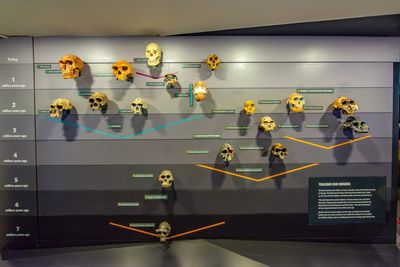


If you spend enough time on social media, or other unreliable places, you’ll come across plenty of pseudo-scientific conspiracy theories.
You’re almost certainly familiar with the most widespread of these: the Earth is flat, the Moon landings were faked, vaccines cause autism, and human activity is not heating the planet.
However, there are also many other theories that fly below the radar, starting with the idea that humans didn’t evolve in Africa.
Many shades of myth
One of the common features of conspiracy theories is the way that they come in lots of overlapping forms, making them slippery to refute.
Some of those who say NASA faked the Moon landings claim Apollo 11 orbited the Moon without landing, others that astronauts could never have crossed the Van Allen Belts, while still more dispute humans have reached space at all.
When it comes to the conspiracy theory that “humans didn't come from Africa”, the variations start with the question of what is human.
Many people assume the word is reserved for members of our species, Homo sapiens, but paleoanthropologists usually include other members of our genus, such as Neanderthals and our suspected shared ancestor H. erectus.
The distinction is important, because the conventional view of human evolution has our genus leaving Africa at least twice. Known as the Out of Africa theory, this model states that H. erectus moved into Asia by at least 1.8 million years ago, and then evolved into new species like H. floresiensis (the “hobbits”) and possibly Neanderthals and the Denisovans.
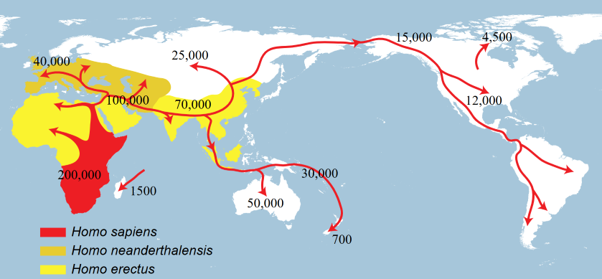
Those who stayed behind in Africa also kept evolving in a slightly different direction, eventually giving rise to our own species H. sapiens. Some of these humans then also moved out of Africa an estimated 60-80,000 years ago on a journey that took us to every part of the planet, and indeed beyond.
Claims that humans first evolved somewhere other than Africa often don’t explain this distinction, so it’s not always clear if they're talking about our genus evolving somewhere else, or if it’s only our species that did so.
More obviously, those taking aim at the Out of Africa hypothesis disagree about where the supposed cradle of humanity actually lies. Some place it in Europe, others in Australia. Some wildly extrapolate from very contested evidence of humans being in North America 130,000 years ago.
How we know Africa is where it all began
The clearest evidence for Out of Africa lies in the fossil record, in the form of both bones and footprints.
Ancient human ancestors like Australopithecus afarensis ( the species to which the famous fossil Lucy belongs) and Paranthropus have been found dating back over five million years.
Although there are gaps in the record, and often we can’t tell exactly how these different species were related to each other, there is enough continuity to suggest both H. erectus and H. sapiens started there too.
Everywhere else, claims of human origins usually rest on a single fossil, which is somehow meant to outweigh all the examples from Africa at similar times.
Even before these fossils were found, Darwin argued that Africa was likely to be where humans evolved because that is where the species most similar to us - chimpanzees and gorillas - are found (with bonobos added after his death).
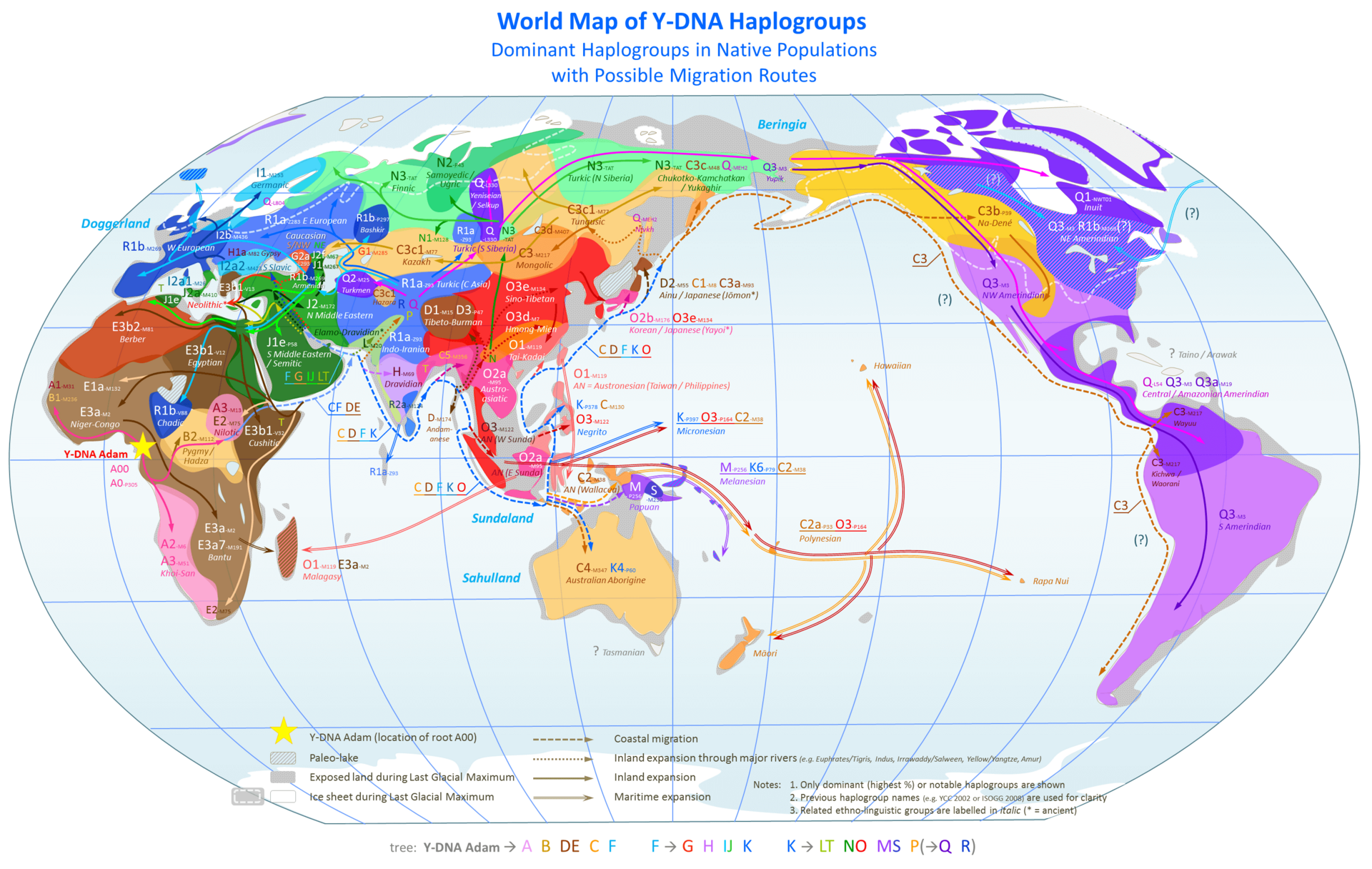
Genetic analysis has added powerful confirmation for this, albeit with a slight twist.
When looking at the family tree of any animal or plant, biologists have found that a particular family usually evolved where the modern diversity is greatest. In their original range, many closely related species or subspecies appear, only a few of which expand more widely. Although species diversify after finding new homes, that seldom matches the variety at the point of origin.
The same tends to be true of genetics within a species, and this is the part that is relevant for us. Two random members of the Khoe-San people of southern Africa will have more genetic differences between each other than individuals from Europe and China will have, or any places outside Africa, for that matter.
This makes sense if everyone who traces their ancestry outside Africa are descended from a relatively small, and therefore genetically homogenous, group who made the great journey tens of thousands of years ago. It would makes no sense at all if humans had inseatd evolved somewhere else, either on a parallel path or migrated back to populate Africa.
But as noted, genetic analysis has added a twist to Out of Africa story. We now know that most of the world has also inherited some of our DNA from Neanderthals, and many people also have some Denisovan genes. The interbreeding responsible for these events took place at multiple sites across Eurasia.
This means that while every person outside of Africa has some Neanderthal DNA, that is not the case for those from within the continent. Again, this supports the argument that it was a small group of our ancestors who left after and then spread around the rest of the world.
So why claim otherwise?
If the evidence is so strong, why then do some people insist on alternatives?
As usual, there are many contributing factors. Firstly, there is the appeal of all conspiracy theories in that some people love to believe they have access to secret knowledge. They want to feel smarter than those who have spent their lives studying human origins, and think they are one of the few who can see through it.
For others, it’s a more parochial thing. Some consider it a point of pride to live in humanity’s birthplace. Part of the reason the Piltdown Man hoax was initially accepted was because so many Europeans wanted to believe their continent was where humans first evolved.
While agreeing on African origins, paleoanthropologists debate whether eastern or southern Africa was a bigger part of the story, and African scientists tend to champion their own locality. It’s not really that surprising some people with less knowledge of the topic will get behind far less plausible claims.
That parochialism can, however, slide over into something more insidious: racism.
Plenty of people hate the Out of Africa theory because it demonstrates we are one people, with far more in common than our differences. Adding on top of that the recognition that, as far as humanity has a home, it’s in Africa, is just too much for many who think of modern-day Africans as inferior.
Naturally, creationists are keen to throw whatever doubt they can on any leading evolutionary model.
Revising our theories
All that said, the human story is complicated, and some discoveries have been made that don’t fit neatly into the original Out of Africa narrative. Tools in northern Australia, for example, have been dated to 65,000 years ago – albeit with some controversy – which is puzzlingly early given all the evidence from other parts of the world.
A fossil found in a cave in Israel is considered to be one of us, rather than a Neanderthal, despite being 180,000 years old, while H. sapiens DNA appears to have been introduced into Neanderthal populations more than 200,000 years ago, and a skull In Greece is also considered to come from our species and be at least 210,000 years old.
Paleoanthropologists have therefore revised their theory, so we now think that H. sapiens made multiple attempts to spread out of Africa when climate conditions were favorable. These were not massively successful, and it was only the final push that seems to have survived and allowed us to spread around the world.
The modest interbreeding that happened during these abortive expansions, followed by the later entry of Neanderthal DNA back into our genome during the last diaspora has led many people to argue there isn’t one cradle of humanity.
Whether you agree with that or not depends on how much of our story you think needs to have taken place somewhere to earn the title of "our cradle". That doesn’t change the fact that most of our evolving, both since we diverged from apes and since to move from H. erectus to H. sapiens, happened in Africa.



 1
1