Space and Physics
 PUBLISHED


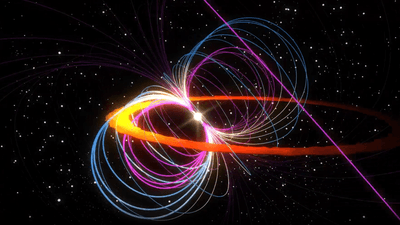


Two puzzling astronomical objects are white dwarfs formed by mergers of less massive white dwarfs, the discoverer of both claims, but they have curious features that suggest they represent a new class. One of them is orbited by a strange half-ring, and the pair proves that after their deaths, stars can have more interesting futures than previously recognized.
As part of her postdoctoral research, Ilaria Caiazzo, assistant professor at the Institute of Science and Technology Austria, found an object, ZTF J2008+4449, releasing X-rays. Long-lasting short wavelength radiation from white dwarfs comes from material raining down on the dead star, which has to come from somewhere.
"We initially thought it was a binary system," Andrei Cristea, who is now doing a PhD under Caiazzo, said in a statement. White dwarfs in binary systems often steal material from accompanying main sequence stars. The most famous consequence of this is when the white dwarf goes nova, but sometimes the white dwarf releases regular bursts of X-rays instead.
However, no signs of a companion were found, and indeed, the team found strong evidence that there isn’t one. In order for material to be transferred between two stars, they need to be very close, which means they’re usually tidally locked. That’s particularly to be expected when the white dwarf is as highly magnetized as ZTF J2008+4449. However, ZTF J2008+4449 rotates every 6.6 minutes; anything orbiting that fast would be unfeasibly close.
Cristea nicknamed ZTF J2008+4449 Gandalf, after the wizard’s habit of speaking in hobbit-mystifying riddles.
"If Gandalf were involved in a binary system, it would have been highly unsynchronized, which might have made it even more puzzling than it already is," Cristea said.
Instead, careful examination of Gandalf’s signal showed a peaked signature that at first appeared similar to those seen when a white dwarf is surrounded by a disk of material. However, in this case, the signal alternated between two peaks over the course of the star’s six-minute spin cycle. "We have never seen anything like that before in any white dwarf," Cristea said.
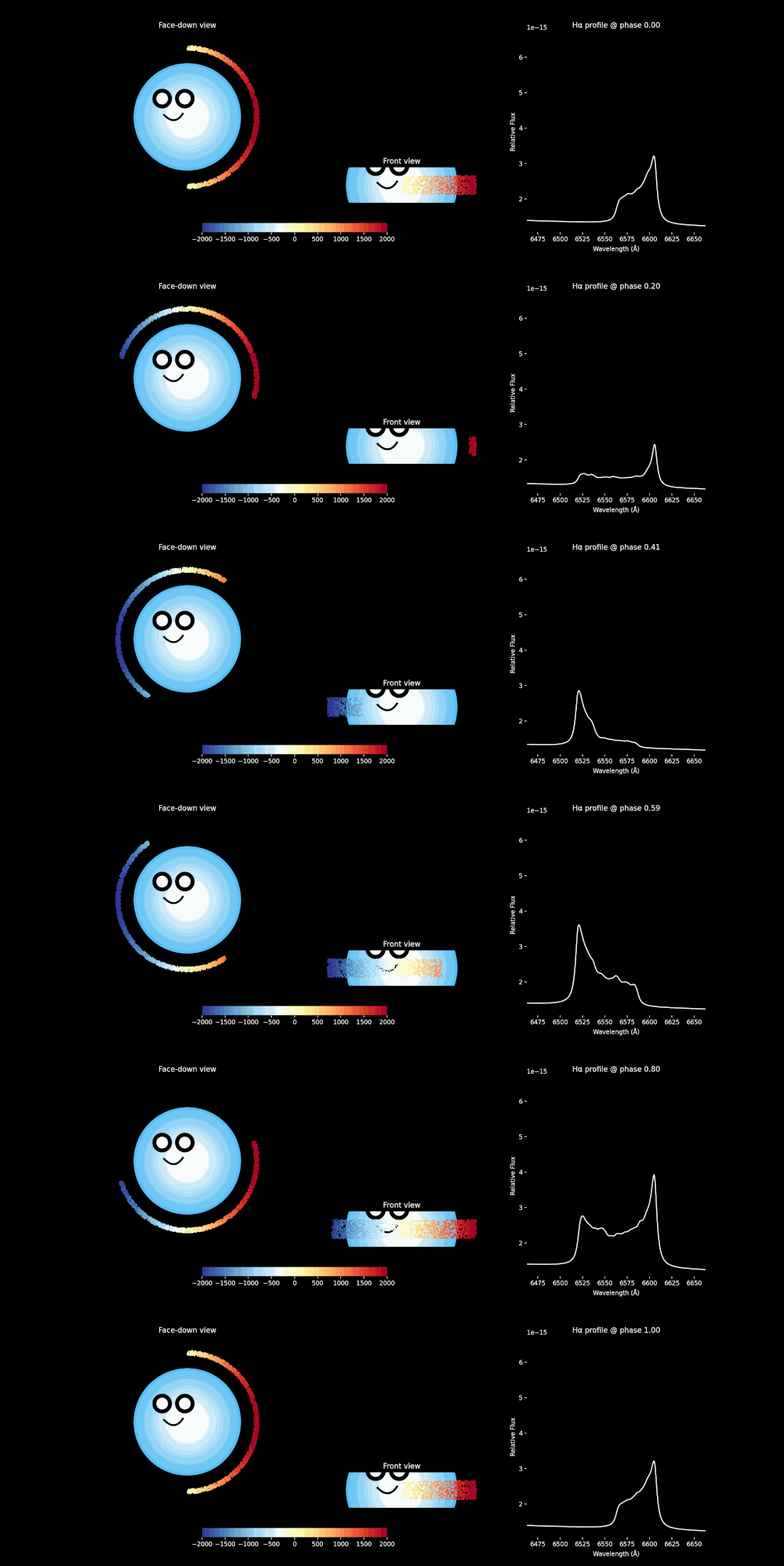
The signal matches what one would expect if there were a half-ring of ionized gas orbiting Gandalf and trapped in its magnetosphere. One peak is associated with the half ring pointing towards Earth, the other with the gap in the ring.
The process by which such a half-ring could form, let alone be maintained, is unclear. However, a point of comparison might be useful. In 2021, Caiazzo discovered another white dwarf, ZTF J1901+1458, which she called “Moon-Sized”, because as the smallest white dwarf ever found, its radius is more like a moon than these typically planet-sized former stars. Despite this, Moon-Sized is very close to the maximum mass a white dwarf can achieve without exploding (30 percent greater than the Sun).
Like Gandalf, Moon-Sized is very magnetic and rapidly rotating. In a preprint still undergoing peer review, another of Caiazzo’s PhD students, Aayush Desai, and co-authors show Moon-Sized has a mass similar to the Sun’s, but its volume is indeed slightly larger than the Moon's.
Besides their masses, extreme magnetism, and rapid rotation, Gandalf and Moon-Sized both lack companion stars and are strong X-ray emitters. Moon-Sized does not appear to have a half-ring, but has a different oddity: its age. Gandalf is thought to have reached its current form from a collision around 60-70 million years ago. Moon-Sized’s formative event is instead up to 500 million years ago, suggesting Tom Bombadil as the most appropriate Tolkien counterpart.
Since magnetism usually fades with time, this means either Moon-Sized has somehow avoided aging, or started off even more staggeringly magnetic. Another potentially significant attribute of Moon-Sized is that it appears to be unpolluted by the material white dwarfs frequently collect from former asteroids or planets they rip apart and consume.
Despite the differences, the points of similarity suggest the two belong to a new class of objects astronomers need to explore. "If we find one new object in the vastness of the universe, what are the chances of it being the only one? Usually, one stellar object with new characteristics is more than enough for us to start looking for similar ones. But here, we actually found two objects with five overlapping features," said Caiazzo. "This is plenty for a new class of star remnants!"
The fact that Moon-Sized is only 130 light-years away, a tiny distance on galactic scales, while Gandalf is about 1,100 light-years off, suggests there are probably many more such anomalies if we can look further afield.
The team proposes three scenarios that might lead to the two stars’ overlapping characteristics.
- A highly magnetized star spinning fast enough to throw off some of its own material, something that has been seen in neutron stars, but never before in white dwarf remnants.
- The merger event left some material behind, which orbited the resulting object in a highly eccentric orbit, falling back only very slowly when the long orbit brought it back to the star.
- The material has a source independent of the merged white dwarf and is slowly being captured.
Desai prefers the first scenario, and Moon-Sized’s lack of pollution contradicts scenario 3, but at the moment, the team are keeping their options open, hoping more examples might reveal which is right.
The study is published in Astronomy and Astrophysics.