


 Space and Physics
 PUBLISHED
 1
1


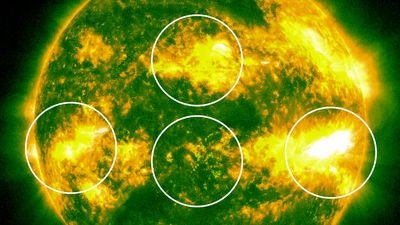


NASA's Solar Dynamics Observatory (SDO) captured a rare phenomenon on Tuesday, April 23: four enormous regions of the Sun exploding simultaneously.
Eruptions on the Sun are a common occurrence, especially as we are around the peak of the Sun's activity cycle, known as the solar maximum. During this part of the Schwabe cycle, sunspots and coronal mass ejections (CMEs) occur regularly, sometimes causing spectacular auroras and radio blackouts on Earth.
"Sunspots are areas where the magnetic field is about 2,500 times stronger than Earth's, much higher than anywhere else on the Sun," the National Weather Service explains. "Because of the strong magnetic field, the magnetic pressure increases while the surrounding atmospheric pressure decreases. This in turn lowers the temperature relative to its surroundings because the concentrated magnetic field inhibits the flow of hot, new gas from the Sun's interior to the surface."
This results in large explosions at the surface. Rarely, pairs of explosions can occur simultaneously, known as sympathetic solar flares. They were thought to be coincidences, but a statistical analysis in 2002 showed that they are not. Instead, they occur as they are linked via magnetic loops.
Rarer still, more than two can occur at the same time, known as a "super-sympathetic" solar flare.
At the moment, it's unclear if the debris from the solar flares will hit Earth, though Spaceweather.com reports that if they do they will do so on April 26. As with most geomagnetic storms, there is likely nothing to worry about – unless you are particularly averse to looking at the beauty of the northern lights, or minor problems with power grids, and radio communication.
Every now and then though, a Carrington Event-sized solar storm can occur, which would pose more of a problem to Earth.


