Space and Physics
 PUBLISHED


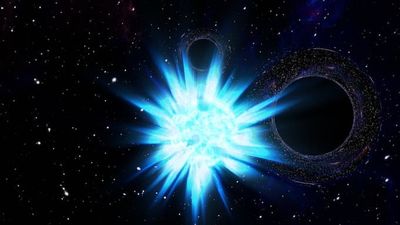


If you know a little bit about stars, you've probably heard that the most massive ones end their lives by exploding: they go supernova. The end product of those events is an extremely dense object, either a neutron star or a black hole. There are some supernovae so energetic that they leave nothing behind, not even a black hole. Researchers have found some intriguing evidence about their existence coming from gravitational wave research.
These events are known as pair-instability supernovae. Any supernova happens because the nuclear fusion at the core of a massive star has stopped. Fusion produces heavier and heavier elements, getting energy out… up to a point. You can’t fuse iron atoms and get energy. Once you get to iron, there is no more energy coming out of the core. Without that energy to push out the outer layers of the star, the gravity starts pulling everything in. The star is going to collapse.
The collapse generates tremendous amounts of energy and often compresses the core into those extremely dense objects. In pair-instability supernovae, though, the collapse gives rise to many nuclear collisions and the creation of matter-antimatter pairs: electrons and their antimatter equivalent, positrons. Whenever antimatter interacts with matter, it turns into pure energy, and this extra energy slows down the collapsing star just enough to stop the formation of a black hole. The whole thing is blown to bits. It’s difficult to confirm whether a supernova was a pair instability, though – they look like other supernovae.
On top of that, not every massive dying star can create these conditions. Only stars that are poor in heavier elements to begin with and have a mass between 130 and 250 times that of our Sun can become pair-instability supernovae. The properties of these events suggest that there should be a mass range of stellar-size black holes that is "forbidden", which means that they can’t form directly from stars exploding.
This range should be between 50 and 130 solar masses. We can’t study black holes with light, but we can measure their properties when a pair of them collides. Scientists can use the gravitational wave signal to estimate the mass of the original black holes, called m1 and m2, and the mass of their union.
Convention dictates that m2 is always the smallest of the pair. The data from the fourth observing run of the LIGO-Virgo-KAGRA collaboration shows that the range of m2 has a cutoff point at about 44 times the mass of the Sun with an uncertainty of about five solar masses.
This same forbidden range is not present in the distribution of m1, and the team has an answer for that. Those primary components tend to spin more quickly, indicating that they might have already experienced a merger, something already found in a recent gravitational wave signal.
“The observation is well explained by pair instability; there are no stellar-origin black holes in the forbidden zone because stars are undergoing pair-instability supernovae. The only black holes in this mass range are made from merging smaller black holes, rather than directly from stars,” project lead, Hui Tong, a PhD candidate from Monash University, said in a statement.
The work suggests that stellar black holes of those masses, between 50 and 130 times the Sun's, are rare. They are rare because they can’t be produced by stars; they are only the product of collisions between black holes.
“We are seeing indirect evidence of one of the most titanic blasts in the cosmos: pair-instability supernovae. At the same time, we are finding that once they are born, black holes can grow via repeated mergers,” co-author Professor Maya Fishbach added.
The study is published in the journal Nature.