Space and Physics
 PUBLISHED
 6
6


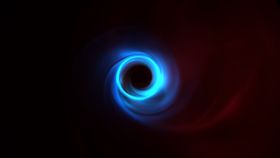


Einstein’s theory of general relativity has just been put to its most stringent test yet, thanks to the incredible first image of a supermassive black hole published last year. Researchers believe that this new test makes it 500 times harder to beat.
General relativity is our best understanding of gravity but it doesn’t mean it can’t be improved upon. We know that it doesn’t work with quantum mechanics, so there’s a better theory out there. This recent test shows just how much this better theory can deviate from the theory of general relativity – and it is very little.
As reported in the Physical Review Letters, the team compared the size of a black hole shadow imaged by the Event Horizon Telescope (EHT) to predictions from general relativity and found an incredible level of agreement.
"We expect a complete theory of gravity to be different from general relativity, but there are many ways one can modify it. We found that whatever the correct theory is, it can't be significantly different from general relativity when it comes to black holes. We really squeezed down the space of possible modifications," lead author professor Dimitrios Psaltis, from the University of Arizona, said in a statement.
General relativity has also been put under a huge number of tests over the last 100 years, passing them all with flying colors. For this work, the team focused on alternative theories that have passed tests in the solar system. This latest one employs a different gauge: the shadow of a black hole.
"Using the gauge we developed, we showed that the measured size of the black hole shadow in M87 tightens the wiggle room for modifications to Einstein's theory of general relativity by almost a factor of 500, compared to previous tests in the solar system," explained co-author Professor Feryal Özel, a senior member of the EHT collaboration also at the University of Arizona. "Many ways to modify general relativity fail at this new and tighter black hole shadow test."
This is only the beginning. Gravitational waves are being used to produce similar tests, and the EHT is undergoing major upgrades that will allow even more precise limits on our understanding of gravity.