Space and Physics
 PUBLISHED



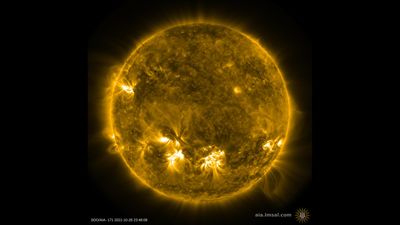


On October 28, 2021, the Sun released a coronal mass ejection. A large swathe of plasma, electrically charged particles from the Sun, was thrown into the Solar System. The material spread out, fanning out and reaching the planets. And for the first time, it was detected on Earth, on the Moon, and on Mars, as well as by spacecraft spread around the inner Solar System.
The measurements collected provide a unique view of the effect of cosmic radiation from the same event, and it was special regardless of where it was studied from. It was a rare "ground level enhancement" event. Those happen when the particles are so energetic that they can penetrate the Earth’s magnetic field and reach the planet’s surface. Since records began in the 1940s, there have been only 73.
Mars and the Moon have no magnetic field, so they are more exposed to cosmic radiation. The Martian atmosphere can block the low-energy particles and slow down the high-energy ones. Still, there is a lot of uncertainty when it comes to the usual dosages of radiation that can be experienced in these worlds.

Radiation doses are measured in grays. Getting a dose of 10 grays would likely lead to death in two weeks. A dose of 700 milligrays would induce radiation sickness. In orbit around the Earth, this coronal mass ejection delivered 10 milligrays as measured by the German satellite Eu:CROPIS Earth orbiter. The level on the Earth’s surface was negligible from a risk point of view.
Around the Moon, NASA’s Lunar Reconnaissance Orbiter measured 31 milligrays. And on the surface of the far side, China’s Chang’e-4, measured 17. On the surface of Mars, NASA's Curiosity measured 0.3 milligrays but in orbit, the European ExoMars TGO reports 9 milligray. Numbers that paint a picture of the radiation risks to future human explorers.
“Our calculations of the past ground level enhancement events show that on average one event every 5.5 years may have exceeded the safe dose level on the Moon if no radiation protection had been provided. Understanding these events is crucial for future crewed missions to the surface of the Moon,” scientist Jingnan Guo, who researched the 28 October event, said in a statement.

Back in 1972, an even more powerful event delivered something around 10 grays to the surface of the Moon. Luckily it was between the Apollo 16 and Apollo 17 missions, so no harm came to any astronaut.
“Space radiation can create a real danger to our exploration throughout the Solar System. Measurements of high-level radiation events by robotic missions is critical to prepare for long-duration crewed missions. Thanks to data from missions like ExoMars TGO we can prepare for how best to protect our human explorers,” Colin Wilson, ExoMars TGO project scientist, said.
The work shows the importance of international collaboration. Data sharing from so many different missions has provided an incredible picture of radiation risk across the Solar System. With more missions on their way and the Sun's activity increasing, there are more opportunities to research this further.
“Currently, we live in a golden age of Solar System physics. Radiation detectors aboard planetary missions such as BepiColombo, on its way to Mercury, and Juice, cruising to Jupiter, add a much-needed coverage to study the acceleration and propagation of solar energetic particles,” remarked Marco Pinto, ESA research fellow working on radiation detectors.
The paper is published in Geographical Research Letters.